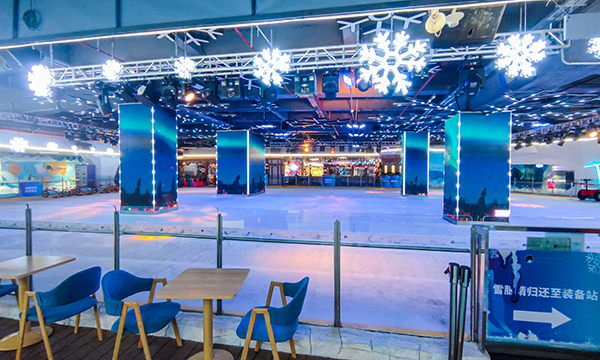

Walk into any new indoor ski project meeting in 2026 and the refrigerant question is no longer a footnote — it's the make-or-break line on the spec sheet. For a facility expected to run 20+ years, the old defaults (R507, R404A, or ammonia) are looking rougher every quarter. What real owners are asking now: can transcritical CO2 (R744) actually deliver on the green-compliance promise without torching the 20-year P&L?
Ammonia (R717) is a great refrigerant on paper. It's also toxic and flammable, which means in a shopping mall, a tourism complex, or any venue where the public walks within the plant room's exclusion zone, you're signing up for a long fight with the local approval authority. Add mandatory gas detection, forced ventilation upgrades, and insurance loadings, and the "cheap refrigerant" math quietly breaks.
HFCs (R507, R404A) sit on the wrong side of the Montreal Protocol's Kigali Amendment. GWP values in the thousands mean regulators in every major market are squeezing them out on a defined timeline. Spec one in a new project today and you're committing to a mid-life retrofit — typically 30–40% of original capex — somewhere in the next decade. That's not a footnote, that's a second mortgage.
R744 has a GWP of 1, is non-toxic, and is non-flammable (ASHRAE A1). That alone removes a long list of headaches. The performance numbers are where it gets interesting, though.
Energy: in cold-winter and temperate climate zones (northern and northeast China, plus the temperate belt running across central China), CO2 spends most of its life in subcritical mode. Measured winter COP runs 15–30% above comparable HFC systems, which on a large indoor snow hall translates to roughly a quarter off the annual cooling bill.
Cascading cooling in one loop: CO2's temperature glide during transcritical heat rejection matches the three cooling jobs an indoor snow hall actually needs — space cooling, sub-floor frost prevention, and dehumidification. One integrated loop, three duties, no parallel ammonia skid sitting next to it.
Waste heat worth real money: transcritical discharge runs 90–120 °C. A well-designed heat recovery package recovers 60–80% of that as high-grade heat for floor heating, snow-melt in the access area, domestic hot water, or driving an absorption chiller in summer. The "cold-and-hot from one source" model reshapes the whole energy budget.
Capex on a transcritical CO2 system runs about 10–20% higher than a baseline HFC install once you price in the high-pressure compressors, micro-channel gas coolers, and the thick-wall stainless pipework. The life-cycle numbers, though, aren't close.
Payback on the capex premium typically lands in 3–5 years from energy and refrigerant savings alone.
You skip the mid-life HFC phase-out retrofit entirely. On a 20-year asset, that's the 30–40% reinvestment that never comes due.
A natural-only refrigerant line-up helps with LEED, China's Three-Star Green Building, and the kind of ESG reporting that opens doors to green credit. Some operators have turned it into a tangible rent and rate premium with anchor tenants who carry their own decarbonization targets.
CO2 is not a drop-in. Operating pressure at the high side hits 130 bar, so every flange, every valve, every branch take-off has to be designed and built for it. Parallel compressor staging and ejector technology have moved fast in the last five years, but the system is sensitive to local climate data in a way HFCs aren't. Sizing a CO2 system off a generic kW-per-m² rule of thumb is a quick way to under-deliver on the COP promise. You need the TMY (typical meteorological year) data for the actual site, run it through a real model, and size both the heat rejection and the heat recovery loops from there.
At Beijing Yangsheng, we've built refrigeration systems across CO2, ammonia, and the new low-GWP blends. The "right" refrigerant for a given indoor snow project depends on the site, the size, and how long the owner actually plans to hold the asset. We build site-specific energy models and full life-cycle cost comparisons on every proposal — TMY data in, numbers out, no hand-waving.
If you're weighing CO2 against the alternatives on a real project, our engineering team can run the numbers with you. Get in touch.
Beijing Yangsheng Ice & Snow Technology Co., Ltd. | Full-service ice and snow venue design, refrigeration system construction, and turnkey project delivery (yssnow.com)