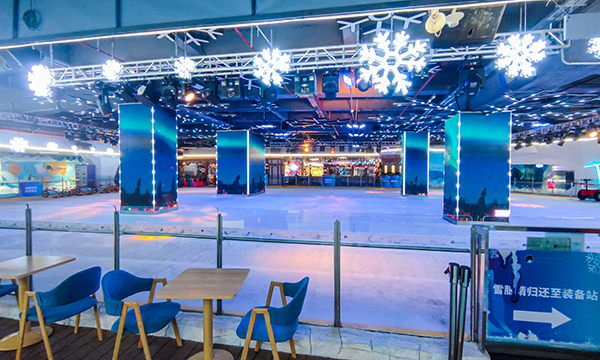

The accessories you'd never think about until something goes wrong. A new rink can spend serious money on the refrigeration system and the ice slab, then blow the whole procurement budget on the wrong skates, mismatched padding, and a dasher board that's basically decorative. Here's what we'd actually tell a friend opening a rink tomorrow.
Skates — three types, three jobs. Buy wrong and you'll have a closet full of skates nobody wants, or a counter full of returns.
Figure skates: toe picks on the front of the blade, stiff boot, very forgiving on bad technique. This is what most public rink customers should put on first. Works for lessons, casual skating, and figure skating practice.
Hockey skates: short, curved blade, much more responsive turning and acceleration. Built for ice hockey rinks and training facilities. Don't put these on beginners — the support is lower and the learning curve is steeper.
Speed skates: low-cut boot, long straight blade, minimal friction. Only for speed skating training, so most public rinks keep a small rack (around 10–15 pairs) and let serious skaters bring their own or rent on the side.
Buy full size ranges from the start. Children's EU 26–35, women's 36–40, men's 41–46, plus a few 47–48 for heavy foot traffic. Skipping the upper men's sizes is the single most common mistake — that's exactly the size you run out of first.
Protective gear — where rink owners get cheap and regret it.
Knee pads, elbow pads, wrist guards, helmets, and especially padded shorts for kids learning to fall. These things get lost, stolen, and wear out fast. Stock 20–30% above what you think you need. Sizes S/M/L for adults, plus a separate youth sizing set. Don't buy toy-store pads — they look fine, last a week, and the liability when one fails is the entire season's revenue.
Dasher boards — the thing nobody thinks about until a kid goes over the boards at speed.
Standard height is 1.07 m for NHL regulation; commercial rinks in China typically run 1.0–1.2 m. The frame should be steel, the facing HDPE (high-density polyethylene) — anything else yellows inside 18 months. Padded top rail is non-negotiable. Rounded corner units at all four corners, not 90-degree joints.
For a new rink, buying accessories from one supplier beats piecing it together.
Cost: skates, pads, and boards are all standard catalog items. A full-package order pulls wholesale pricing — typically 20–40% under what you'd pay buying the same items across three vendors. That's real money on a new build where every line item hurts.
Logistics: one PO, one delivery window, one contact. Sizing and quantity get coordinated up front. The alternative is three calls, three shipments, three invoices, and one of them late on opening day.
Fit: a supplier who actually does rinks will look at your square meters and your target customer (kids? tourists? hockey league?) and tell you the right mix. Otherwise you're guessing 50 pairs of figure skates for a rink that should've been 30 figure / 20 hockey.
A reasonable opening inventory for a 400–600 m² public rink:
50 pairs of skates — split 50/50 figure and hockey. Sizes 26–35, 36–40, 41–46 in roughly a 3:4:3 ratio.
50 sets of protective gear — S/M/L in a 3:3:4 ratio (more L than you'd expect; adults are heavier users). Plus 10 extra knee pad sets and 10 extra padded shorts as wear replacements.
Dasher boards — measured to your rink perimeter, with 50 mm-thick padding on the kick strip and rounded corner units at all four corners.
Optional consumables to bundle — skate sharpening tools, replacement blades, rental cubbies.
Don't buy from retail e-commerce single-item at a time. Prices run 2–3x wholesale, sizing is whatever happens to be in stock, and the quality varies batch to batch. If something breaks, you're on your own.
Do find a source-level supplier that ships all three categories — skates, pads, boards — and can do full-container delivery. Lock sizing specs, quantities, delivery schedule, and warranty terms into the contract upfront. Lower price, stable supply, and a paper trail if something goes sideways.
Beijing Yangsheng Ice & Snow Technology Co., Ltd. | Full-service ice and snow venue design, refrigeration system construction, and turnkey project delivery (yssnow.com)