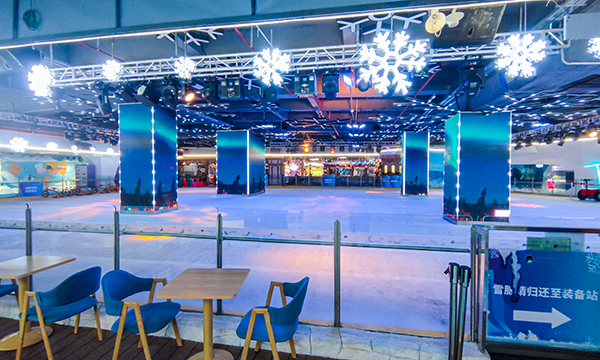

Fog above the ice, dripping roofs and condensation on barriers are often blamed on an undersized dehumidifier. The root cause may be earlier: a unit selected by floor area without counting ventilation, doors, skaters and 600 sqm ice rink cost breakdown.
An ice rink is not a dry warehouse. Its air must remain comfortable for people while keeping the dew point low enough to protect cold surfaces. ice rink construction and refrigeration that problem.
Relative humidity changes with temperature. Air at the same moisture content becomes more humid in relative terms as it cools. A reading of 55% RH therefore does not, by itself, prove that condensation is impossible.
Use dew-point temperature alongside RH. If a roof panel, duct or barrier is colder than the room-air dew point, condensation can occur. The design must compare indoor conditions, ice temperature and actual surface temperatures.

| Load | Design question |
|---|---|
| Outdoor ventilation air | Is the unit selected for summer design weather, not only winter? |
| Doors and infiltration | What happens during opening hours and peak entrance traffic? |
| Skaters, spectators and staff | Are both activity and occupancy peaks included? |
| Envelope diffusion and leakage | Has the vapour-pressure difference across the cold enclosure been checked? |
| Cleaning and resurfacing | Are short moisture peaks included rather than averaged away? |
For a preliminary ventilation-load estimate:
W = rho × L × (outdoor humidity ratio - indoor humidity ratio) / 1000
W is kg/h, L is outdoor airflow in m3/h, and humidity ratio is g/kg. People, infiltration and process loads must then be added.
For illustration only, outdoor air at 26C and 60% RH, an indoor target of 12C and 55% RH, and 3,000m3/h of ventilation produce roughly 28kg/h of ventilation moisture load. A real design must use local summer weather, scheduled occupancy and the actual building envelope.

Condensing equipment can be practical in warmer spaces with moderate dew-point targets. In a cold rink, coil frosting, defrost periods and low-dew-point capability need specific verification. A catalogue rating measured in a warm room is not an ice-rink rating.
Desiccant systems are generally better suited to low dew points and continuous rink operation. They also introduce regeneration heat, exhaust air, ductwork and heat-recovery decisions. ice and snow equipment's actual entering-air and regeneration conditions.
Do not divide total load by a catalogue number and stop there. Check that both figures use the same conditions, then review part-load control, maintenance tolerance, airflow, external static pressure and installation space. Multiple units can stage capacity between quiet and busy periods; N+1 redundancy is a business decision based on downtime risk, not a universal rule.
A calculated 40kg/h load does not automatically mean one nominal 40kg/h machine is enough. Ask when that rating is available, what happens during regeneration or defrost, and whether duct resistance reduces the delivered airflow.
A rink may have acceptable average humidity but still develop fog over the ice or dripping at one roof corner. Supply air should cover the ice and known cold bridges; return air should not short-circuit. Entrance lobbies, air curtains and door management reduce direct humid-air infiltration.
Refrigeration, HVAC and dehumidification controls should work together. Surface temperatures change during pull-down, and moisture load changes with occupancy. A fixed RH setpoint alone cannot manage every operating state.
What entering-air and regeneration conditions support the rated capacity?
What are the itemised summer moisture loads?
How does the system control part load?
What is the regeneration energy source and where does its heat go?
What are the leakage, filter-pressure and external-static assumptions?
How do low-temperature and fault protections work?
Where are the RH and dew-point sensors located and calibrated?
Will acceptance include occupied, door-open and post-resurfacing conditions?

Log temperature and humidity above the ice, near the roof, around seating and at the entrance. Compare readings with nearby surface temperatures and Indoor ski facility cost and cooling. A good handover shows that moisture load, low-dew-point capacity, airflow and controls work as one system.
The example is illustrative, not a project quotation or equipment rating.