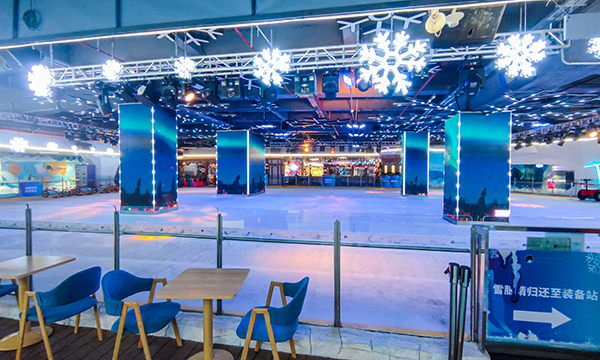

Anyone who has run a 600 m² real ice rink for a couple of seasons knows the truth: the line item that quietly drains the budget is not the equipment depreciation. It is the monthly electricity bill. In a typical indoor rink, refrigeration runs year-round, and electricity alone can account for 30 to 40% of the total operating cost. The number is not fixed. Most rinks leak large amounts of that power through four places that nobody bothers to check. This piece is not a lecture about grand theory. It is four things we have actually measured on real projects.
The single easiest win in a refrigeration plant is the easiest to overlook. Compressor power draw is tied almost directly to the condensing temperature. The hotter the refrigerant condenses, the harder the compressor has to work. The industry rule of thumb: for every 1 °C rise in condensing temperature, cooling capacity drops about 3% and power consumption climbs about 2 to 3%. Pull the condensing temperature down and the power bill follows.
Why does the condensing temperature drift up in the first place? The most common culprit is a fouled condenser. On an air-cooled condenser, a mat of dust, catkins, and oil film on the fins kills the heat transfer. On a water-cooled plant, scaled fill and uneven water distribution in the cooling tower do the same thing — they push the condensing pressure up.
The fix is not exotic. Quarterly wash of the air-cooled fins with a pressure washer or coil cleaner. Annual check of the cooling tower spray nozzles and fill, with descaling. Keep the plant room ventilated so multiple units do not dump hot air into each other. If the budget allows, add variable-speed drives to the condenser fans so the fan speed tracks the load. Doing these few things keeps the condensing temperature in a sensible band, and shaving ten percent off the summer power bill is normal.
Most rinks run indirect refrigeration. The compressor cools a charge of glycol, and the glycol is what actually runs through the pipes under the ice. The concentration of that glycol decides both its freeze point and how well it transfers heat.
If the concentration is off, two things go wrong at once. The freeze point climbs, and at the worst end of that, the glycol can freeze inside the pipes under the ice pad and burst them. Even before that, a weak concentration drags the heat-transfer efficiency, which forces the compressor to work harder for the same cooling load. The power bill climbs.
There is a quieter problem hiding in the same loop. Glycol oxidises over time. The oxidation products are acidic. Once the pH drifts down, the loop starts eating itself — the pipework, the plate heat exchanger, the pump impellers. By the time a plate heat exchanger starts leaking or a pipe section bursts, the project is looking at a major repair job, not an efficiency tweak.
The remedy is a once-a-year concentration and pH check. Keep the concentration mocked to about 8 to 10 °C below the lowest evaporating temperature — typically 40% in a temperate site, 50% in a cold site. If pH drops below 7, treat it as a warning and change the fluid before the acid eats anything expensive. When a fluid change comes around, use a purpose-formulated rink glycol with the inhibitor package already in it. Generic industrial glycol looks cheaper on the invoice, and it costs more over the life of the plant.
In a warm and humid climate, the silentest power drain on a rink is not the refrigeration at all. It is the moisture in the air. The ice pad sits at about -3 to -5 °C, the building air at 10 to 15 °C, and the temperature difference plus a wok stream of warm bodies from a busy public session drives the indoor humidity straight up. Once that humid air touches the ice, it ices and fogs the surface. The quality of the ice suffers. The refrigeration system also has to deal with the latent heat load that the dehumidification should be handling.
On a lot of rinks in southern China, the dehumidification plant is drawing about as much power as the refrigeration plant. When the dehumidification design is weak — or when the system just relies on the refrigeration to handle humidity as a side effect — the electricity bill does not move.
The fix is to run a dedicated dehumidification plant sized for the load, and to keep the building slightly pressurised so humid outdoor air is not migrating in through doors every time someone walks in. A door curtain or an air lock on the main entrance pays for itself in months. The dehumidification coils and the reheat coil need a regular check, the same way the refrigeration coils do.
There is one stream coming out of a refrigeration plant that almost every rink throws away — the rejected condenser heat. The compressor dumps it to atmosphere through the condenser. For a facility that also needs hot water for the changing rooms, space heating, and snow-melt systems, capturing that stream is one of the cleanest efficiency moves available, and one of the most overlooked.
Heat recovery in a typical commercial rink can usefully recover 30 to 40% of the rejected condenser heat. Translated into a year's running costs, that is often five figures of saved electricity or gas, and the payback on the recovery equipment is typically one to three years.
There is a side benefit that is easy to miss. A well-designedrecovery system steadies the condensing loop, which lets the compressor run at a more favourable condensing temperature. In other words, the system saves power on the refrigeration side before you even count the value of the heat it has recovered. Energy efficiency and longer equipment life fall out of the same design.
The key point is that heatrecovery has to be planned at design time. Retrofitting it later means re-piping the plant room, adding new storage, and re-engineering the controls — at a cost that no longer makes sense against the remaining life of the equipment. The right moment to design heatrecovery in is the original build, or a major refit. For a new project, it is one of the few measures that pays for itself reliably and pays for itself again every year after that.
Refrigeration efficiency in an ice rink is not a single big move. It is four smaller things, done consistently.
| Place to act | What to do | What it buys |
|---|---|---|
| Condending temperature | Clean coils, ventilate, variable-speed fans | 10% power saving |
| Glycol management | Annual concentration and pH check, purpose-formulated fluid | Efficiency and major-repair avoidance |
| Dehumidification | Dedicated system, building pressure control | Visible peak-shaving |
| Heat recovery | Planned at design stage | 30 to 40% condenser heat recovered |
Refrigeration is a bit like a car. Treat it as a water pump and it eats fuel every day. Service it the way the manual says and it will sit there quietly and cheaply for a decade.
Beijing Yangsheng Ice & Snow Technology Co., Ltd. | Full-service ice and snow venue design, refrigeration system construction, and turnkey project delivery (yssnow.com)