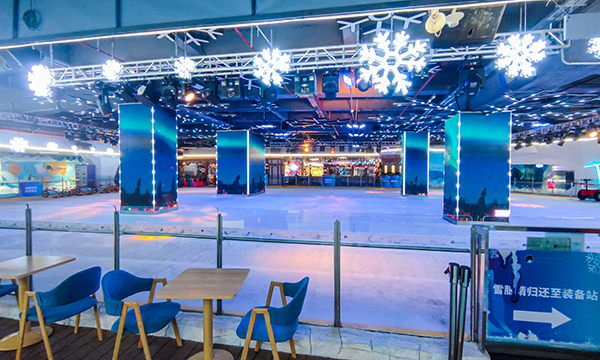

Mall owners want the foot traffic a skating rink brings. They don't want crews tearing up the floor, blocking corridors, or scaring off shoppers. We've been putting mobile rinks in commercial spaces for years, and our standard delivery is 9 days from "the trucks pulled in" to "first kid's skates on the ice." Here's the actual timeline.
Every project starts the same way. The operating window is 4 months, summer only, because that's when families are looking for indoor activities. When the season ends, the whole setup comes apart and moves to the next venue. Nothing permanent, nothing welded, nothing poured into the building.
The non-negotiables we sign off with mall management before any work starts:
No damage to the existing space. Original floor, decoration, building structure — all of it goes back to the way we found it.
No disruption to daily operations. Mall stays open the entire build. Shop fronts stay visible. Shoppers keep walking through.
Full reusability. Every piece of equipment comes apart clean and gets redeployed at the next site. That's what makes a 4-month seasonal rink pencil out financially.
Two layers go between the rink and the original floor. First a moisture barrier film, then high-strength protective board over the top. The cold side of an ice rink produces a lot of condensation. Without the barrier, that water gets into the original flooring and warps it within weeks. With it, the floor comes back looking like we were never there.
The refrigeration units and the main control panel don't sit in the middle of the rink where customers see them. They go in a reserved side area off the main atrium. All the piping between the machinery and the ice gets wrapped in protective sleeves. Cleaner look, easier to service, and the rink itself stays the visual centerpiece.
The rink barrier is a modular system: custom aluminum frames with high-transparency acrylic panels. It meets the national ice rink safety standard, but because the acrylic is clear, shoppers walking past can see the skaters inside. Half the marketing value of a mall rink is the visibility from the corridor, and the barrier can't kill that.
This is the part most operators don't see. Once the refrigeration system is commissioned, we don't flood the rink and freeze it in one go. We pour in 2–3mm layers, freezing each one before the next goes down, until the total thickness hits 25mm. The first freeze takes 36 hours. End result: an ice surface that stays flat and hard well past the standard most rinks accept.
The rink isn't "done" on day 9. The local operations team is just starting. We hand over a custom Daily Ice Maintenance Manual written for their specific rink layout, and a technician stays on site for two weeks running the staff through everything: resurfacing, edging, emergency procedures. By the time we leave, their own crew is running it.
Two problems show up at every mall rink that nobody warns you about upfront.
Condensation around the rink. Mall atriums are open spaces. The HVAC, the foot traffic, the doors opening to outside — all of it shifts the air around the rink constantly. Cold air spills out, hits the warmer mall floor, and you get a wet slip hazard. We install water-absorbent anti-slip mats around the rink perimeter and custom sealing strips along the bottom of the barrier. Cuts the cold spill to almost nothing, kills the slip problem.
Ice quality under mall conditions. Mall ice is harder to maintain than a purpose-built arena rink. Mall lighting, the HVAC, the constant foot traffic past the boards — all of it adds heat to the ice and breaks the surface down faster. Maintenance runs roughly twice as often as a fixed rink. The on-site training makes sure the local crew can hit that schedule without us around.
Beijing Yangsheng Ice & Snow Technology Co., Ltd. | Full-service ice and snow venue design, refrigeration system construction, and turnkey project delivery (yssnow.com)