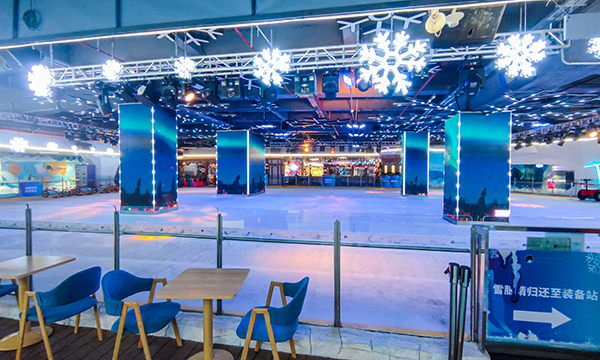

Weekend nights put ice quality to the test. Hundreds of skaters, hard hockey practices, noisy parties — and if your ice still looks like a mirror at the end of it, you've got a top-tier commercial ice resurfacing machine and a crew that knows how to run it. If the surface is chewed up by the time you reopen, you're going to hear about it, and the venue's reputation takes the hit.
In day-to-day operations, the resurfacer is the venue's beating heart. The chiller builds the ice; the resurfacer rebuilds it, 8 to 12 times a day, every day, for years. Picking the right one is the foundation of running a quality venue.
People outside the industry lump every resurfacer together as "the ice machine." In reality, a good resurfacer runs two precision operations at the same time:
Millimeter-level shaving. A sharp blade scrapes off 2–3 mm of damaged surface — the gouges from hockey stops, skate nicks, and the junk that gets dragged in off rubber flooring.
Hot water resurfacing. Right behind the blade, a water applicator lays down an even sheet of 60–70°C water. The hot water fills in the micro-grooves and bonds with the cold base ice in a single pass, leaving a glass-smooth surface.
Here's the standard: a high-quality resurface keeps ice thickness variation across the rink to under 0.5 mm. If resurfacings are too infrequent or the equipment is off, surface temperature uniformity drops by 1.5–2°C — that's exactly when skaters start complaining the ice feels "sticky."
First-time buyers often fixate on sticker price and miss the long-term cost picture.
Electric units are the long-term winner for indoor rinks. Zero emissions, low noise (65–72 dB typical). The purchase price runs 15–25% higher, but you save on fuel, cut HVAC exhaust load, and skip the oil and belt changes. The premium typically pays for itself in 3–5 years.
Resurfacers run 1.8 to 2.5 meters wide. Bigger isn't automatically better — match it to your rink:
Under 800㎡ rinks: 1.8–2.0 m width is the sweet spot. 8–10 passes to cover the rink, easy to drive, fits through standard service doors, doesn't need a dedicated storage bay.
800–1,800㎡ rinks: 2.2–2.5 m heavy units pull their weight. Wider coverage cuts resurfacing time from 12 minutes down to 7–8. Run that 12 times a day and you've freed up roughly 290 extra "prime ticket hours" a year.
Water tank trade-off: A 200 L tank needs more frequent refills on an 800㎡ rink. A 400–500 L tank covers 6–8 cycles without a refill, dropping the operator's back-and-forth significantly.
There aren't that many well-known resurfacer makers in the world, but the difference between a good ice resurfacing equipment supplier and a bad one shows up six months after delivery.
Parts availability. Blade cartridges need replacement every 30–50 hours. Water pumps and applicator cloth are wear items. If the supplier can land original parts at your venue within 48 hours, that's worth paying a brand premium for — every day the machine is down, you're losing real money.
Training depth. These machines aren't plug-and-play. Blade height calibration, water temperature tuning, travel speed control — operators need 2–3 weeks to dial it in. Suppliers who send a senior tech on site for commissioning and training get you to top-tier ice quality in year one.
Warranty commitment. 2 years on the core drivetrain, 1 year on the whole machine minimum. That's the floor for a manufacturer who actually stands behind their product.
Beijing Yangsheng Ice & Snow wasn't a machine maker to start with. For 15 years, we built turnkey ice rink projects — everything from 200㎡ research chambers to 1,800㎡ commercial mall rinks. We spent years doing the service and repair work, which is exactly how we figured out what venues actually need from a machine.
Drawing on that field experience, we developed our own line of all-electric commercial resurfacers (1.8 m and 2.2 m working widths). They're built for the pace of real, high-volume commercial operation and have held up in everything from Beijing winters to Guangzhou summers.
We build these resurfacers to the same standard as the rinks we construct — but the price fits a commercial venue's actual ROI model. If you're planning a new rink or looking to replace an aging machine, we'd like to talk.
Whatever you end up choosing, take the resurfacer purchase seriously. It's more critical than the chiller, and more visible than the boards around the rink — because every skater on your ice is going to see what it does.
Get in touch
Specialty: 15 years of ice rink design and construction, refrigeration engineering, full turnkey service; in-house commercial resurfacers, snowmaking systems, and refrigeration solutions for commercial facilities.
Email: info@yssnow.com
Website: yssnow.com
*Beijing Yangsheng Ice & Snow Technology Co., Ltd. | Full-service ice and snow venue design, refrigeration system construction, and turnkey project delivery (yssnow.com)