
China’s ice-and-snow market in 2026 is no longer coasting on Beijing 2022. Policy funding, lower-carbon refrigeration technology and a change in who pays for skating and skiing are arriving together. For developers, the opportunity is real, but it belongs to projects whose demand model and engineering model agree.
The strongest signals are not simply more venues. They are Beijing’s retrofit and low-carbon incentives, a southern pipeline of indoor mega-complexes, mixed-use formats that increase foot traffic, and controls that reduce facility energy. Here is how I would read those signals before committing to a design.

Beijing spent 2025–2026 rolling out an upgraded ice-and-snow industry plan. Its importance extends beyond the capital: Beijing is the anchor, while the funding logic and case studies can be exported elsewhere. That matters because indoor ice and snow is capital-intensive and slow to amortize. Public support for part of the capital expenditure can change the investment return calculation, but it does not remove the need for a sound operating model.
The practical step is to identify which policy line applies to the project before treating support as secured. The plan includes:
Technical retrofits: larger subsidies for upgrading indoor venues.
Green operations: stronger incentives for green and low-carbon operation.
Talent development: dedicated funding for reserve-talent training pipelines.
Hybrid tourism: tax breaks for ice-and-snow plus tourism formats.
For an existing venue, a retrofit case may be more relevant than a new-build narrative. For a hybrid attraction, the tourism element may matter alongside the refrigeration plant. When comparing indoor ice and snow solutions, keep the subsidy assumption separate from the base-case operating forecast, then test whether the venue still works without optimistic policy timing.
Walk the indoor-ski pipeline in 2025 and 2026 and the bulk of new square metres is in the south: Guangdong, Yunnan, Fujian and Sichuan. These are places where outdoor skiing is not a realistic alternative. The southern and subtropical all-season indoor snow-and-ice complex has moved from niche format to dominant format.
Two engineering changes made the arithmetic more credible. First, high-density insulation has caught up. Boards of 100 mm+ XPS, correctly detailed, can cut conductive load hard enough that a 30,000-m² snow hall in Foshan is no longer a science project. Second, refrigeration options and the installation base have developed. R507 and newer lower-GWP blends are carrying loads where CO2 would be overkill, while the wider install base has brought unit cost down.
Do not translate that into a standard southern specification. The useful lesson is that envelope detailing, refrigeration selection and project scale must be calculated together. A developer should ask for the load basis behind every equipment choice and should not use the Foshan area as a proxy for another site.

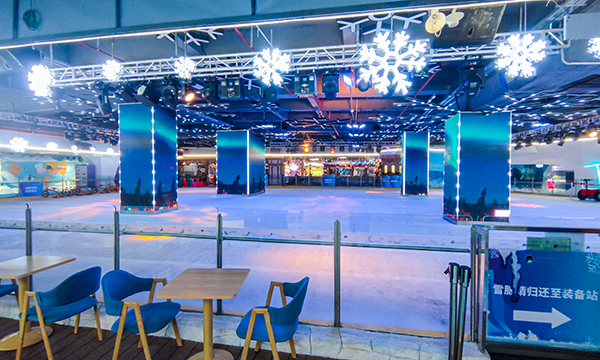
A standalone rink or ski hill does not pencil out in most malls in 2026. The stronger approach is to stack ice or snow with another reason to visit. This is not decoration around the plant; it changes the brief for circulation, shared services and operating zones.
Ice-and-snow plus children’s education is one example. MELAND-style indoor children’s parks attached to a small ice surface are drawing family foot traffic in tier-1 and tier-2 mall anchors. Ice-and-snow plus action sports is another: scooter parks, trampolines and skate zones sharing HVAC with the ice plant can cut both capital and operating expenditure.
Retail and food and beverage complete the experience-anchor model, converting visits into dwell time. If you are assessing an ice and snow park for a mall, define which uses share systems and which need independent conditions. The commercial mix and the technical zoning should be developed together, not handed to engineering after the tenant plan is fixed.
The intelligent label on a refrigeration control panel used to be marketing. In 2026, the described control stack is contributing to operating margin. PLC-based central control allows multi-zone independent setpoints. Remote digital-twin monitoring can identify a drifted expansion valve before it costs a slab of ice. Integrated energy dashboards connect performance to the building’s BMS.
Venues running this stack report 15–20% lower facility energy than the same floor area on legacy controls. On a 20,000-m² snow hall, that difference can represent six to seven figures a year, depending on the local tariff. Treat that as a reported market result, not a guaranteed saving: your own baseline, control sequence, climate and tariff still need to be modelled.
| Decision area | Practical data | Design response |
|---|---|---|
| Envelope | 100 mm+ XPS with proper detailing cuts conductive load. | Include the envelope in site-specific load calculation. |
| Refrigeration | R507 and newer lower-GWP blends serve where CO2 is overkill. | Select for the actual project, not a copied plant list. |
| Controls | Reported facility energy is 15–20% lower than legacy controls on the same floor area. | Specify zone setpoints, remote monitoring and BMS-linked dashboards. |
| Scale references | Foshan snow hall: 30,000 m². Energy example: 20,000 m². | Neither example is a quotation or design template for your site. |
Yangsheng has spent 15 years in refrigeration plant design, dehumidification, high-specification insulation envelopes and long-tail service contracts that keep an ice surface flat for a decade. Its work covers very different climates and scales: the snow system at Guangzhou Sunac Snow World, smaller commercial rinks in malls in Foshan and Guangzhou, and climate-controlled friction laboratories used by national teams.

That laboratory experience is a useful reminder that an environmental test laboratory and a public snow hall require project-specific engineering. The common thread is not a particular machine. It is site-specific load calculation, custom dehumidification design and a refusal to copy equipment lists. Reviewing project cases helps clarify scope, but it should not replace calculations for your venue.
For a new project, start with the actual site data, the intended ice or snow format and the proposed supporting uses. For an existing venue, add the operating baseline and the symptoms: energy performance, ice quality or both. Yangsheng’s engineering team can run a side-by-side model on actual site data, which is more useful than comparing headline equipment specifications.
No. The policy floor can improve the investment mathematics when government underwrites part of the capital expenditure, but indoor venues remain capital-intensive and slow to amortize. Beijing’s funding logic and case studies may travel, yet a developer still needs to confirm local support and test the venue’s operating case rather than treating a subsidy as assured income.
Not as a complete specification. The Foshan example combines 100 mm+ XPS with proper detailing to cut conductive load. It does not make one board thickness suitable for every climate or venue. Yangsheng’s stated approach is site-specific load calculation and custom dehumidification design, so the example should inform your model, not replace it.
Provide actual site data and explain whether you are sizing a new project or troubleshooting an existing one. For an existing venue, identify whether the concern is energy, ice quality or both, and gather the available operating information. With that basis, Yangsheng’s engineering team can develop a side-by-side model instead of offering a generic equipment list.
If your next venue needs a credible demand brief and a buildable refrigeration strategy, speak with Yangsheng Ice and Snow. Ask for a site-specific review of your actual data before fixing the envelope, plant selection or control scope.