
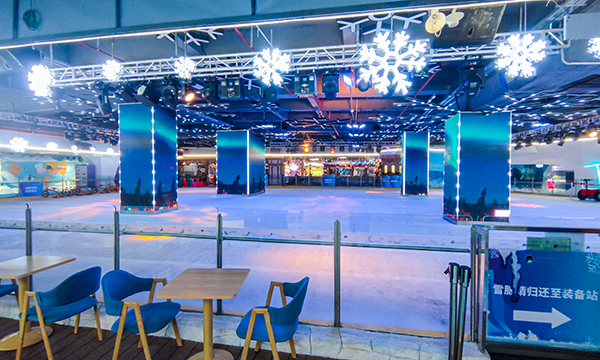
An ice and snow laboratory is easiest to assess when published facts are separated from the design questions they raise. The Yantai project gives venue owners a compact reference: a laboratory in Yantai, China, covering 200㎡, operating at -5℃, and opened in 2023.
Its configuration combines a refrigeration snow making system, a snow feeding system, and a ski friction system. Snowmaking is automatic, simulates pure natural snow technology, and uses pure tap water. This overview keeps to those facts, then identifies what an owner should clarify before treating the project as a reference.

The published brief is unusually concise, so it should not be stretched into claims about capacity, test methods, energy use, or equipment models. None of those details is supplied. What is supplied is enough to establish the project’s identity, its stated environment, and the three functional parts named by Yangsheng Ice and Snow.
Readers can place that outline beside the company’s wider environmental laboratory work, while keeping this Yantai summary as the sole basis for the project facts below.
| Item | Published project data |
|---|---|
| Project name | Ice and Snow Laboratory |
| City | Yantai, China |
| Type | Ice and snow laboratory |
| Scale | 200㎡ |
| Temperature | -5℃ |
| Opened | 2023 |
| Named systems | Refrigeration snow making, snow feeding, and ski friction |
| Snowmaking | Automatic, simulating pure natural snow technology |
| Snowmaking water | Pure tap water |
The three-part description is the most useful engineering information in the source. It separates snow production from snow delivery and from the ski friction system. For an owner preparing a brief, that separation supports clearer questions about scope and interfaces without assuming any undocumented machinery, layout, or performance result.
Refrigeration snow making system: The source names this as one part of the laboratory and associates the project with automatic snowmaking. It does not publish a machine model or output figure.
Snow feeding system: This is listed separately. A proposal should therefore explain its intended role and its connection with snow production, rather than leaving snow feeding as an undefined package label.
Ski friction system: This is also named, but no test procedure or result is given. Ask the supplier to define the supplied scope and the information the owner needs to review.
Taken together, the names describe a sequence worth discussing during design: making snow, feeding snow, and addressing ski friction. That is an interpretation of the listed parts, not a claim about an unpublished control sequence. The actual operating philosophy should be confirmed in project documentation.

Automatic snowmaking is stated directly, as is the use of pure tap water. The technology is described as simulating pure natural snow. Those points belong in a requirements discussion, but they do not establish snow volume, snow quality criteria, water consumption, or cycle time; the source provides none of these. A responsible specification should request the missing performance information instead of attaching invented figures to the Yantai project.
For a venue owner, pure tap water should remain a project fact, not be expanded into an unpublished treatment process. Ask what water requirements apply to any proposed equivalent system and how automatic operation will be demonstrated. Also request a clear distinction between the natural-snow simulation description and the measurable acceptance criteria for the installation being proposed.
During technical review, keep the three descriptions separate: the project’s automatic control claim, its water-source statement, and its natural-snow technology description. Each should be represented accurately in tender documents, with any proposed performance measures listed as requirements for the new project rather than retrospective facts about Yantai.
The stated scale is 200㎡ and the stated temperature is -5℃. They are valuable reference points, but they are not a universal design template. The source does not explain room construction, airflow, insulation, occupancy, or test duty. Consequently, this article does not derive a cooling load or recommend dimensions for another laboratory.
A new brief should start with its own intended activities and site constraints, then ask the designer to explain the proposed environment and system boundaries. Owners comparing a laboratory with a visitor attraction can review Yangsheng Ice and Snow’s indoor ice and snow solutions for context, while keeping laboratory requirements separate from entertainment requirements.
A reference project becomes useful only when it improves the questions in your own procurement process. For a Yantai-inspired discussion, keep the request grounded in the published system names and require project-specific answers.
Scope: Identify what is included under refrigeration snow making, snow feeding, and ski friction, and show where supplier and owner responsibilities meet.
Snowmaking: Confirm how automatic operation and tap-water snowmaking apply to the proposed design, without assuming the Yantai equipment model.
Interfaces: Request an explanation of how the named systems are coordinated and what information will be provided for design review.
Verification: Agree how the proposed installation will be checked against the owner’s requirements; do not cite unpublished Yantai results as acceptance evidence.
Documentation: Ask for operating and maintenance information appropriate to the actual offer, since the source does not list the laboratory’s documentation or service arrangements.
Keep the request for information equally disciplined. If a proposal includes capacities, utility demands, layouts, or controls, those should be presented as details of the new offer. They should not be written back into the Yantai case study. This distinction lets the owner compare bids without turning missing source data into apparent precedent.
It is also sensible to compare the structure of other project cases, but not to transfer their conditions automatically. A different city, venue type, or opening date would describe a different project, not evidence about this one.

It is in Yantai, China. The source identifies the project as an ice and snow laboratory, gives a scale of 200㎡, states -5℃, and lists 2023 as its opening year.
The laboratory consists of a refrigeration snow making system, a snow feeding system, and a ski friction system. No equipment model or additional subsystem is specified in the supplied project summary.
Snowmaking is automatic, simulates pure natural snow technology, and uses pure tap water. The source does not provide output, consumption, timing, or snow-quality measurements, so none should be inferred.
Before requesting a proposal, venue owners can browse Yangsheng Ice and Snow’s news and technical articles for related engineering topics. Then contact Yangsheng Ice and Snow with your intended use, site information, and required scope, and ask for a laboratory proposal that states its assumptions as clearly as the Yantai project states its core facts.