
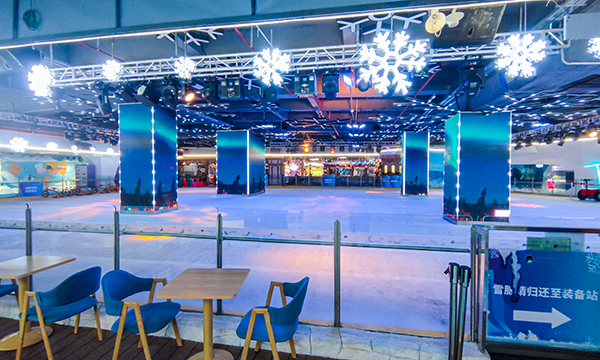
Traditional snow guns stop being useful when the venue cannot supply cold air. They spray water into sub-zero conditions; above 0°C, those droplets fall as water rather than snow. That is why a summer mall event or an indoor slope needs a different production method.
High-temperature snowmaking is that method, but buying the snowmaker alone is not a venue design. The sound decision starts with operating days, peak temperature and location, then covers refrigeration, insulation, dehumidification, power and routine maintenance.
A conventional snow gun sprays water into cold air and lets sub-zero temperatures freeze the droplets. Once air rises above 0°C, the result is water, not snow. A high-temperature system instead cools water to freezing point through a closed-loop heat exchanger and produces dry ice flakes at -5°C. No chemical additives are involved, and the refrigerant remains sealed in its own circuit.
Treat the two outputs as different materials. Traditional guns make wet snow; these systems make dry flakes. The flakes melt about three times slower than ordinary snow, and one pass with a groomer produces firm, skiable snow. That changes both snow retention and the work needed to prepare the surface.

Before comparing models, test the project against three thresholds. Any one of them puts high-temperature snowmaking on the procurement list.
Snow days: 300 is the dividing line. If an outdoor northern resort needs only 60 days a year, traditional guns are fine. For 300 or more, high-temperature production is the only route.
Peak summer temperature: 28°C is the practical checkpoint. Below it, traditional guns plus night operations can still work. Above it, they are effectively dead.
Indoor or outdoor: mall atriums, indoor slopes and film stages have no cold outdoor air to rely on. An indoor brief therefore points directly to high-temperature equipment.
Do not average these answers away. A venue with a cool annual average can still fail the peak-temperature test, and a northern indoor site still has no natural cold air. Record all three conditions before requesting a quotation.
The 2026 production lineup covers compact integrated units, split systems and a 1-to-2 multi-split. Use the snowmaking equipment range as the starting point, then select by daily output, installation type and coverage rather than by the machine price alone.
Integrated machines suit small to medium snow scenes, mall atriums, partial film sets and pop-up events. Their core selection figures are:
| Model | Daily output | Coverage | Power consumption |
|---|---|---|---|
| Ys2-01 | 200 kg | 20 m² | 1.2 kWh/h |
| Ys4-02 | 600 kg | 40 m² | 2.5 kWh/h |
| Ys4-03 | 1,200 kg | 40 m² | 5.0 kWh/h |
All three integrated models use R404A or R454C refrigerant and list an operating temperature of 40 to -30°C. The Ys2-01 weighs 100 kg yet produces 200 kg of snow daily because the heat of fusion is recaptured in the refrigeration loop. Its plug-and-play format makes it the go-to choice for mall pop-ups.
Split machines separate the indoor and outdoor units and suit large indoor ski slopes, snow parks and year-round commercial venues. Listed daily outputs are 1,200 kg for the Ys10-01, 2,400 kg for the Ys10×2-02 and 3,600 kg for the Ys10×3-03, with noise below 55 dB. Every unit includes PLC control and remote IoT. Operators can monitor machines, start or stop them remotely and receive fault alerts on a phone; across dozens of units, that can save a full-time technician.
The 1-to-2 multi-split uses one outdoor unit to drive two indoor units. It lists approximately 2.4 m³ of daily output, 7.5 kW total input and PLC, remote IoT and group control. Its main value is not eliminating one outdoor unit; it is uniform multi-point coverage. On a long indoor slope, snow made at one end can melt before reaching the other, while simultaneous generation keeps depth consistent along the run.

For indoor ski slope projects, combine split machines with high-temperature snowmaking and plan generation points along the slope. The longer the run, the stronger the case for 1-to-2 multi-point production rather than relying on a single discharge location.
Mall atrium pop-ups: for Christmas, New Year and brand events lasting 1 to 4 weeks, one Ys2-01 covers 20 m² at 200 kg per day. It is plug-and-play and needs no site preparation.
Snow parks and snow towns: use the Ys10 split series with PLC remote group control for play areas and family zones, reducing operations labor.
Film and television shoots: container modules provide stable, controllable snow on the production schedule. A sound stage cannot wait for traditional guns to receive cold weather.
Cold-therapy facilities need a different brief. A small snow room solution can produce -5°C dry flakes for a few minutes per session, serving recovery areas, hotel spas and gyms. Here, controllable output and the cold-zone envelope matter more than covering a large slope.

Most costly mistakes sit outside the snowmaker itself. Check these four items before committing to equipment.
Budgeting only for the snowmaker. The machine may be only 30 percent of the total. Refrigeration, insulation and dehumidification are the budget eaters. A poorly insulated 1,000 m² cold zone can burn 300,000 RMB a month in summer electricity, so price the complete system.
Underestimating southern humidity. Winter humidity in the south can push snow water content 5 to 10 percent higher than in the north, making it melt faster. Add dehumidification and keep the cold zone below 60 percent relative humidity.
Checking power after delivery. A single high-temperature unit draws 30 to 150 kW, and older malls and factories often cannot supply it. Obtain a power-upgrade plan from the utility before signing.
Assuming 365-day operation is automatic. Without cold-zone maintenance, filter cleaning and refrigerant leak checks, output can start dropping after three months. A maintenance contract and one or two dedicated operators are the real prerequisite.
They are enough for an outdoor site with natural cold and only 60 snow days a year. Traditional equipment has lower typical CAPEX. Indoor venues, southern China projects, 300-plus operating days and cold-therapy rooms point to high-temperature snowmaking, whose higher CAPEX includes equipment, refrigeration and insulation.
The machine can run for 365 days, but continuous availability depends on cold-zone upkeep, clean filters and refrigerant leak checks. Budget for a maintenance contract and dedicated operators rather than treating year-round output as automatic.
Provide the floor area, daily output target and operating days. Also identify whether the venue is indoor or outdoor, its peak summer temperature and the available power supply. Those details allow the output, coverage and supporting cold-zone system to be configured together.
High-temperature snowmaking is infrastructure for an indoor or year-round venue, not a luxury add-on. Share your floor area, daily output target and operating days with Yangsheng Ice and Snow for a project-specific proposal and quotation. The right configuration makes snow output, refrigeration, insulation, dehumidification and maintenance work as one system.