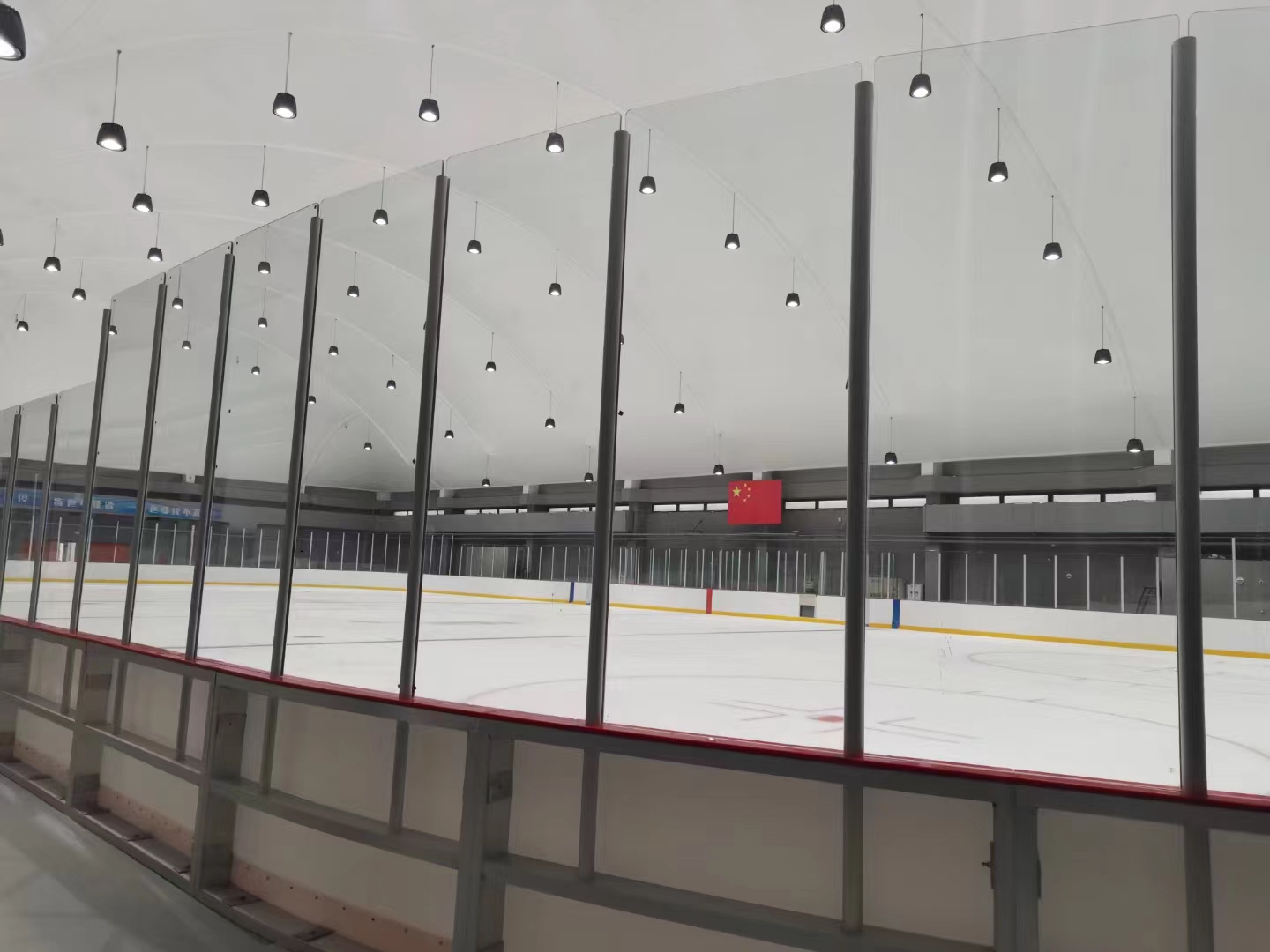
Owners often ask whether a thicker sheet of ice is "safer". In an indoor rink it usually is not. Forty millimetres is enough for most commercial rinks. Going to 60 mm adds refrigeration load, energy use and build-up time, and raises the risk of cracking.
Structural slab, waterproofing, insulation, pipe bedding, base ice with markings, and the top skating layer. Only the top layer is the thickness people argue about; the rest only needs to cover and protect.
Mall and family skating: 30–35 mm, warmer ice, faster build-up
Hockey training: 30–40 mm with lower ice temperature
Figure skating: 40 mm, because jump landings concentrate load on the toe pick
Outdoor seasonal rinks: 60–80 mm, where thickness compensates for sun and shutdowns
A landing is a point load, not a spread load. Too thin and the pick punches through to the pipe bed, leaving pits that resurfacing cannot repair. Above 40 mm the benefit falls away quickly while temperature uniformity gets harder to hold.
More heat to remove, a larger temperature drop between brine and surface, a lower evaporating temperature and therefore more compressor energy per unit of cooling. A well-run indoor rink typically sits near 1.7 kWh per square metre per day over a year; extra ice pushes that line up. Build-up also takes longer, since ice is sprayed in 1–2 mm layers, and thermal stress across a thick sheet increases the risk of cracks.
Layer-by-layer flooding at 1–2 mm, controlled water temperature, ice temperature held at design value after build-up, fixed measuring points at corners, centre and near the boards, and a written log of layers, water temperature, ice temperature and humidity.
Thickness within design range at every measuring point, even surface temperature, no through-cracks or exposed base, 40 mm verified for figure skating with a landing-impact check, and a build-up log rather than a certificate alone.
Thickness is a design decision, not insurance. Use 30–40 mm indoors, 40 mm for figure skating, and question any specification above 60 mm for a permanent indoor rink.
See our real ice rink systems and refrigeration systems pages, the 700 sqm Guangzhou Grandview rink case, and the ice rink maintenance note for day-to-day pitfalls.
Ranges and examples are illustrative and do not replace a project-specific design review.