
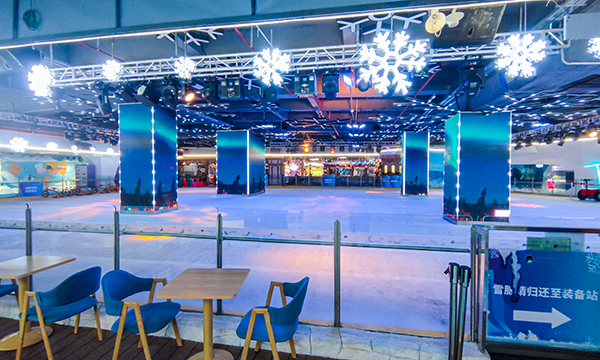
A vacant shopping-mall atrium can look like wasted space, but a real ice rink only makes sense when the building economics work. Many operators retreat after pricing a fixed rink: it can run into the million-yuan range, require floor reinforcement and take months to build, creating disruption most malls cannot accept.
A mobile ice rink offers a different route. Its refrigeration and ice surface are modular and detachable, allowing fast setup and teardown without floor demolition or major renovation. The right question is not simply whether tickets cover the equipment; it is whether the rink can perform as a seasonal traffic asset for the mall.

The business model follows the asset. A permanent fixed ice rink normally relies on tickets, training and memberships, supported by long-term operations and steady foot traffic. Its upfront cost is high and payback is long, but once operating, it can produce ongoing cash flow.
A mobile ice rink should not be assessed as a smaller standalone venue. It can serve one event and then move to the next location, so its value lies in lower investment relative to a fixed rink, fast turnover and the ability to draw people into the mall. Treating it as a ticket-only attraction misses that distinction.
Start with a practical reference: a 200 m² mobile real ice rink, supplied as a full package, typically costs from a few hundred thousand yuan to just over one million yuan. Venue rent is not included. Site conditions, a custom-shaped ice surface and the refrigeration configuration determine where a project sits within that broad range.
Ice-surface modules
Refrigeration equipment
Rink barriers
Installation and commissioning
Before forecasting payback, keep the delivered scope and the commercial assumptions separate. The package covers the physical rink and its commissioning; it does not answer who provides the atrium, how rent is handled or whether events have been sold.
| ROI input | Planning benchmark | Decision use |
|---|---|---|
| Reference rink | 200 m² mobile real ice rink | Use only as a reference; final cost depends on site conditions, ice shape and refrigeration configuration. |
| Package scope | Ice-surface modules, refrigeration, barriers, installation and commissioning | Typically ranges from a few hundred thousand yuan to just over one million yuan; venue rent is excluded. |
| Ticket base | 40–80 yuan per person in tier-2 and tier-3 cities | Treat as base income only; tickets alone do not cover the investment. |
| Busy period | Winter break and holidays; a few hundred visitors on a busy weekend | Supports demand planning, but does not replace events or mall traffic value. |
| Season test | 3–6 month winter project | One-season break-even or profit is realistic only when the investment case and income stack apply. |

Tickets are the base, not the whole case. In tier-2 and tier-3 cities, single-session tickets usually run 40–80 yuan per person. Winter break and holidays are peak season, and a busy weekend can bring a few hundred visitors. Even so, ticket sales alone will not cover the investment.
The larger return is the traffic created for the mall. Measure the opportunity by how many people enter the building, how long they stay and what they spend in nearby restaurants and shops. That surrounding commercial value is usually much greater than rink ticket revenue, which explains why some malls offer free space or even pay a subsidy to host a mobile rink.
Private bookings add the upside. Corporate team-building, parent-child days, brand pop-ups and school study trips can be scheduled alongside public skating. One private booking can earn as much as several days of walk-in tickets, without consuming peak-season capacity for casual skaters. These event revenues should be pursued before opening day, not after a weak ticket forecast becomes visible.
When structuring the venue discussion, relevant ice and snow project cases can help frame the delivery conversation, while your own site plan should set out the location, event calendar and proposed mall terms.

Location comes first, even when the atrium commands higher rent. Place the rink where family customers and holiday crowds already gather. A mobile rink sells an instant experience; without foot traffic, the operating concept has no foundation. A cheaper but quiet position does not solve that problem.
Next, treat the rink as a hook rather than a self-contained attraction. Its job is to make people stop and create buzz for the mall. That is the value to bring into negotiations, alongside a realistic explanation of how tickets, private events and seasonal programming will work together.
The preferred commercial structure is a low-rent or subsidy arrangement combined with revenue sharing. A rent waiver or subsidy recognises the wider foot-traffic benefit, while the event plan supports the rink's own income. Securing that balance can make the project economics substantially lighter than relying on walk-in sales alone.
A one-season payback is possible, but only under specific conditions. The rough case is a 3–6 month winter project with an investment of a few hundred thousand yuan. When tickets, private bookings and mall subsidies or rent waivers are stacked together, breaking even or even making a profit within one operating season is realistic.
Confirm the package scope, site conditions, ice-surface shape and refrigeration configuration before using the cost range.
Keep venue rent outside the package figure, then show clearly whether the actual deal uses rent, a waiver, a subsidy or revenue sharing.
Build the revenue case in layers: public tickets first, private bookings second and confirmed mall support third.
Lock in team-building, parent-child events and study trips before opening, and choose the atrium for family and holiday traffic.
Also run the downside honestly. If the venue is dead, the project relies only on tickets and no events are operated, the result is a guaranteed loss on a fixed asset. In practice, payback depends half on the investment and half on whether event operations can genuinely be delivered.
No. A fixed rink is a long-term venue with ongoing cash flow from tickets, training and memberships. A mobile rink is a low-investment, fast-turnover, mall-traffic-driven model. Its modular hardware enables relocation, but the return still depends on location, events and the mall partnership.
No. Tickets provide the base, with 40–80 yuan per person as the stated single-session range in tier-2 and tier-3 cities, but they will not cover the investment by themselves. Private events and mall support are essential parts of the payback case.
Confirm the full equipment and commissioning scope, the site and refrigeration requirements, and the treatment of venue rent. Choose a high-traffic atrium, secure private bookings and event business, and negotiate the mall's rent waiver, subsidy or revenue-share contribution. Without those pieces, a one-season forecast is not well supported.
Yangsheng Ice and Snow provides full-service ice and snow venue design, refrigeration system construction and turnkey project delivery. Bring your site conditions, preferred ice-surface shape, operating window and proposed mall terms to the team, and learn more about Yangsheng Ice and Snow before committing to a payback forecast. A sound mobile-rink decision starts with the right scope and ends with an operating plan the mall can actually support.