
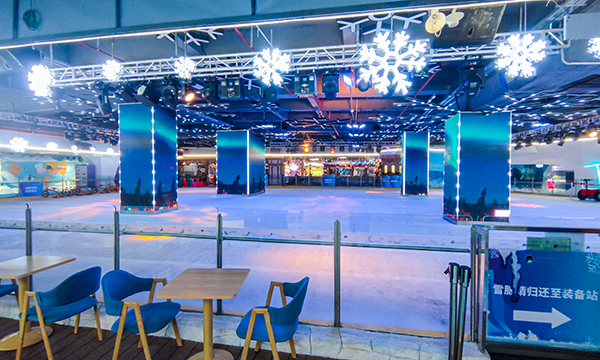
FOLIVE PARK in Chongqing is described in the project source as a 13,500-square-meter super-sized space combining indoor ice and snow activities with outdoor rock climbing, Italian racing and bowling, sand camping, and other recreational and social experiences. It is a family-friendly sports and leisure destination developed and operated by Shanghai Fuxing Sports.
For a venue owner, that confirmed scope is more useful than a list of assumed technical specifications. This review separates the published project facts from the engineering questions they raise, so the case can inform a brief without inventing a rink size, refrigeration duty, snow condition, or opening programme.

The source identifies the overall space, not the area assigned to any individual attraction. It also does not divide the venue into public, back-of-house, or equipment zones. Accordingly, the 13,500-square-meter figure should be read as the scale of the whole destination, never quoted as the footprint of its ice and snow portion.
The published activity mix is equally important. Indoor ice and snow activities sit within a wider destination that also includes outdoor rock climbing, Italian racing and bowling, and sand camping. The source characterises the result as multi-level recreational and social experiences, but it gives no layout, visitor capacity, or attraction-by-attraction schedule.
| Venue element | Source-confirmed information | Briefing use |
|---|---|---|
| Overall destination | 13,500-square-meter super-sized space | Treat as whole-venue scale, not ice and snow area |
| Indoor attraction scope | Indoor ice and snow activities | Define the detailed attraction brief separately |
| Other experiences | Outdoor rock climbing; Italian racing and bowling; sand camping | Review interfaces without assuming a layout |
| Project roles | Shanghai Fuxing Sports develops and operates; Yangsheng contributed design and equipment supply engineering services for the ice and snow attractions | Keep responsibilities explicit |
That distinction keeps a headline venue area from being transferred into an equipment conversation. A supplier needs the confirmed attraction scope and interfaces, while the area figure remains useful context for the destination as a whole. The published record supports that disciplined reading; it does not support a more detailed technical description.

A mixed leisure destination should not be briefed as a collection of isolated names. I would ask the owner to identify which decisions are fixed, which are still open, and which party approves each interface. For FOLIVE PARK, the source confirms the activity mix and the principal roles; it does not reveal how those activities were arranged or how visitors move between them. Those unanswered items belong in a project-specific review, not in a case-study caption.
The ice and snow scope deserves the same care. “Indoor ice and snow activities” is the only published description of the attraction content. It should not be expanded into a particular rink format, snow product, room configuration, or equipment model. Instead, the design team can use the confirmed wording as a boundary and request the missing operating brief directly from the venue stakeholders.
Confirm the intended guest experience before discussing equipment selection.
Record which spaces and services are shared with other attractions, and which are dedicated.
Separate public experience requirements from access needed for design, supply, and future operation.
Give every interface a named reviewer so that design decisions can be traced and approved.
Keep unpublished areas, capacities, temperatures, and performance figures out of the project brief until they are verified.
This approach is concrete because it changes the next meeting agenda. Rather than asking for a generic attraction package, the owner can table a responsibility matrix, an experience brief, and a list of unresolved interfaces. Each document can then be checked against the source-confirmed scope before any further detail is added.
When comparing this approach with other ice and snow project cases, apply the same rule: use what each published record actually states, and treat everything else as a question for the project team.
The clearest engineering lesson in the source is the stated role of Yangsheng Ice and Snow: contributing design and equipment supply engineering services for the ice and snow attractions. That wording matters. It establishes a contribution to both design and equipment supply engineering, but it does not say that Yangsheng developed or operated the destination. Shanghai Fuxing Sports holds those roles in the source.
For an owner developing a different venue, the practical response is to coordinate design intent and equipment information from the outset. The equipment discussion should respond to the agreed attraction brief, while the design review should record the information needed to integrate that equipment. This is a recommendation for scope control, not a claim about unpublished FOLIVE PARK drawings or machinery.
A useful submission register can group information under attraction definition, spatial interfaces, utility interfaces, access requirements, supply boundaries, and operating handover. None of those headings presumes a technical value. They simply give the design and supply teams a common place to confirm what is known, what is pending, and who must provide it. Owners reviewing ice and snow equipment should ask for the same clarity rather than selecting from product names alone.
Where the attraction sits within a broader indoor destination, indoor ice and snow solutions should also be assessed against the venue’s confirmed operating concept. That keeps the conversation focused on suitability and coordination. It avoids presenting a generic system as though it were the specified FOLIVE PARK solution, which the source does not establish.

Before moving from a case-inspired concept into detailed design, I would close the following questions in writing. They are deliberately qualitative because the source provides no project-specific technical values.
Attraction boundary: What exactly belongs to the indoor ice and snow scope, and what belongs to another experience?
Experience brief: What should a family or social group be able to do, and which parts of that brief are fixed?
Venue interfaces: Which adjacent activities, shared spaces, or operating teams must be consulted?
Supply boundary: What information must accompany equipment selection so the design and supply scopes remain consistent?
Verification: Which statements still need a drawing, an agreed requirement, or written confirmation before they can be used?
This checklist also protects public-facing project communication. If a value has not been confirmed, leave it out. If a role has been confirmed, state it precisely. If an activity is known only by a broad label, retain that label. The resulting brief may look less dramatic than a specification-heavy sales page, but it gives designers, suppliers, and operators a reliable basis for their next decisions.
For FOLIVE PARK, that reliable basis is concise: a large multi-activity destination in Chongqing, a stated overall area, a family-friendly leisure positioning, named development and operation responsibility, and a defined Yangsheng contribution to the ice and snow attractions. Everything more detailed should come from authorised project information, not inference.
The source gives an overall space of 13,500 square meters. It does not publish the area of the ice and snow attractions, so the overall figure must not be presented as their footprint.
Yangsheng contributed design and equipment supply engineering services for the ice and snow attractions. The source separately identifies Shanghai Fuxing Sports as the destination’s developer and operator.
No. It does not provide an equipment model, attraction dimension, temperature, capacity, or technical performance value. Those details require separate confirmation and should not be inferred from the activity names.
If you are planning a comparable ice and snow attraction, bring your confirmed scope and unanswered interface questions to Yangsheng Ice and Snow. Contact Yangsheng Ice and Snow to discuss design and equipment supply engineering requirements without assuming specifications that your project has not verified.