
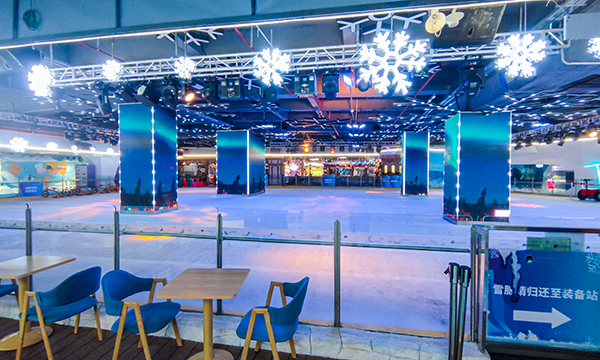
A rink or ski hall is a coordinated building system, not a refrigeration unit dropped into a room. The design must connect the venue’s purpose, ice or snow quality, energy use, installation and operating plan from the first brief.
For an owner, the practical question is who carries each interface. This guide uses Yangsheng Ice and Snow’s stated capabilities and project results to show how indoor ice and snow solutions can be planned as one EPC scope, from traffic flow and equipment selection to training and after-sales support.

Start by stating whether the venue must serve competition, public skating, a commercial event, family snow play or several uses. Site conditions, budget and target audience should drive traffic-flow design and equipment selection. That sequence keeps the layout tied to the operating brief instead of treating the venue as a machine purchase.
Professional ice rinks: precise temperature control and mirror-smooth surfaces, with the stated offer meeting international IIHF and ISU competition standards.
Modular portable ice rinks: rapid assembly for campuses and commercial events where space is constrained.
Indoor ski halls: leisure slopes through professional-grade high-altitude runs, with year-round temperature control.
Ice and snow parks: snow play, ice sculptures and entertainment combined for immersive family interaction.
Multi-purpose venues: flexible conversion concepts, curling and ice hockey within one operating plan.
If a permanent venue is unavailable, the modular portable ice rink approach uses prefabricated pipe supports and quick-connect technology for building-block-style assembly. It can be installed in sports arenas, convention centers or outdoor plazas, then dismantled and transported after the event. Yangsheng reports a 30% reduction in construction costs for this approach. The decision is therefore not simply permanent versus temporary; it is whether assembly, removal and reuse fit the intended programme.
Assess refrigeration on energy recovery and control as well as cooling. Yangsheng’s CO₂ transcritical direct cooling ice-making technology uses a natural refrigerant described as environmentally friendly and pollution-free, and the technology was also used at the Winter Olympics. Recovered heat can support venue heating and hot water for the ice resurfacing machine. The reported result is more than 30% energy savings compared with traditional methods. For a new project, use that figure as a source benchmark to examine against the proposed design and operating conditions.
Ice quality needs separate acceptance criteria. The intelligent temperature-controlled ice-making system maintains ice-thickness accuracy within ±0.5 mm and temperature fluctuation at ≤1°C. The source links that precision to the edge feel required in short-track speed skating and the cushioning required for figure skating. Ask for the intended skating use to be explicit in the control brief, rather than accepting a promise of cold ice alone.
A ski hall also requires environmental control beyond snowmaking. CFD airflow simulation is used to optimize temperature and humidity distribution, eliminate fogging in large spaces and prevent snow compaction. The design objective is dry powder snow on the slopes and a comfortable visitor experience. This is why refrigeration, snowmaking and airflow should be reviewed together for a large indoor slope.

Yangsheng describes its one-stop role as general contractor, providing EPC services from project initiation to opening. For an owner, that scope should make four work stages visible:
Planning and design: use site conditions, budget and target audience to determine traffic flow and equipment selection.
Smart equipment manufacturing: source core refrigeration units, ice resurfacing machines and snowmaking systems from proprietary or strategic research and development bases.
Engineering installation: professional construction teams follow strict ISO quality management systems, with attention to every joint and pipe connection.
Operations and maintenance: provide operational training, energy-saving guidance and 24/7 after-sales support after delivery.
Procurement should sit inside that sequence. Review proposed refrigeration, resurfacing and snowmaking equipment against the chosen venue type, not as an isolated catalogue exercise. The equipment must serve the layout, environmental-control objectives and intended visitor experience established during planning.
Do not treat opening day as the end of the technical relationship. Training and energy-saving guidance connect the installed system to the people who will run it, while continuing support gives the operator a defined route back to the service team. Project delivery is the beginning of operations, not the disappearance of the contractor’s responsibilities.
Project figures are useful only when read alongside the work they cover. The following data comes directly from the source technology descriptions and cases; it is not a universal promise for another site.
| Venue or system | Design or delivery measure | Source-reported result |
|---|---|---|
| CO₂ direct cooling system | Natural refrigerant and heat recovery for venue heating and resurfacer hot water | Over 30% energy savings versus traditional methods |
| Precision ice control | Intelligent temperature-controlled ice making | Ice-thickness accuracy within ±0.5 mm; temperature fluctuation ≤1°C |
| Modular mobile rink | Prefabricated pipe supports and quick-connect assembly | Construction costs reduced by 30% |
| Commercial complex rink | Structural reinforcement through ice formation | Completed in 45 days; over 1,000 visitors daily |
| Convertible sports arena | Removable wooden flooring and intelligent ice making | Scene transitions within 48 hours; annual utilization over 80% |
| Large indoor ski resort | -5°C cold-zone insulation and large-space refrigeration and temperature control | Slopes with nearly 100 m of elevation drop |

These examples highlight different owner priorities. The commercial-complex case combines a 45-day programme with subsequent daily attendance above 1,000. The arena case centres on changeover speed and annual utilization. The ski resort case concerns refrigeration and temperature control across a massive space, enabling an all-weather, all-age snow destination. Compare the ice and snow project case background with your own site, audience and intended use before treating any figure as a project target.
Yes. The modular system is designed for sports arenas, convention centers and outdoor plazas. Prefabricated pipe supports and quick-connect technology allow building-block-style assembly; after an event, the rink can be dismantled and transported. The source reports 30% lower construction costs for this technology. Whether it suits your project still depends on the site conditions, budget, audience and intended programme established during planning.
For ice, the source specifies thickness accuracy within ±0.5 mm and temperature fluctuation at ≤1°C. For the CO₂ transcritical direct cooling system, it reports more than 30% energy savings and heat recovery for venue heating and resurfacer hot water. These are distinct claims: one concerns surface control, the other energy performance. Keep both attached to their stated system and compare them with your own design brief.
The stated one-stop service includes operational training, energy-saving guidance and 24/7 after-sales support. Before that stage, the EPC scope covers planning, equipment manufacturing and engineering installation. An owner should therefore review the whole handover path: how the layout serves the audience, how core equipment is selected, how joints and pipe connections are controlled, and how the operating team is supported.
Bring your site conditions, budget, target audience and intended venue uses to the first discussion. Contact Yangsheng Ice and Snow for a project consultation, and ask for planning, equipment selection, installation and operator support to be connected in one proposal. Identify which source-project benchmarks are relevant to your brief, then build the rink, mobile ice surface, ski hall or ice and snow park around clear operating goals.