
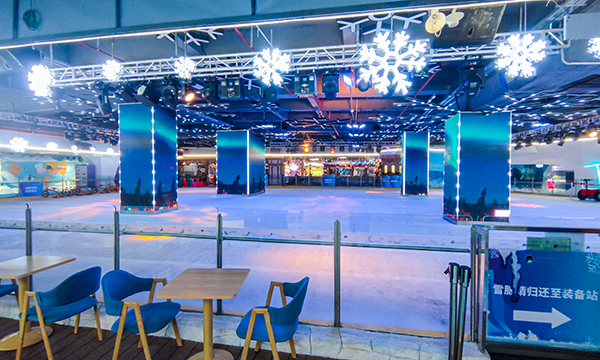
An empty shopping-mall atrium can look like an obvious opportunity for a real ice rink. Then the fixed-rink quotation arrives: million-yuan-range investment, floor reinforcement and months of construction. For most malls, that level of cost and disruption stops the discussion before operations are even considered.
A mobile ice rink changes the proposition. Its refrigeration and ice surface are modular and detachable, allowing fast setup and teardown without floor demolition or major renovation. The important question is not simply whether it costs less, but whether tickets, events and mall-driven foot traffic can repay the investment.

Start with a 200 m² mobile real ice rink as the reference. The full package covers ice surface modules, refrigeration, barriers, and installation and commissioning. Excluding venue rent, it typically costs from a few hundred thousand yuan to just over a million. Site conditions, a custom-shaped ice surface and the refrigeration configuration explain the variation, so a headline price alone is not a useful basis for an ROI decision.
Ask for the scope of any mobile ice rink system to be clear on those items. Compare it with a fixed ice rink on construction disruption as well as capital: the mobile package can run one event and move to the next location, while a fixed rink depends on a long-term installation.
| Planning item | Source figure or condition | Practical interpretation |
|---|---|---|
| Mobile reference | 200 m² real ice rink | Includes modules, refrigeration, barriers, installation and commissioning |
| Package cost | A few hundred thousand yuan to just over a million | Venue rent excluded; site, ice shape and refrigeration affect the scope |
| Fixed-rink benchmark | Million-yuan range | Requires floor reinforcement and months of construction |
| Single-session tickets | 40–80 yuan per person | Reference for tier-2 and tier-3 cities |
| Winter operating model | 3–6 months | Assess tickets, private bookings and mall support together |
| Busy-weekend potential | A few hundred visitors | Possible peak turnout, not a season-wide attendance assumption |

A fixed rink commonly relies on tickets, training and memberships. It needs steady long-term foot traffic, carries a high upfront cost and has a long payback period, but can produce ongoing cash flow once established. A mobile rink should be assessed differently: it is a traffic asset for the mall rather than a standalone venue.
Ticket sales provide the base. Winter break and holidays are peak season, and a busy weekend can bring a few hundred visitors. Even so, tickets alone will not normally cover the investment.
Foot traffic creates the wider commercial return. The mall cares about how many people enter the building, how long they stay and how much they spend in nearby restaurants and shops. That value can be much greater than rink ticket revenue.
Private bookings add upside. Corporate team-building, parent-child days, brand pop-ups and school study trips can be scheduled alongside public skating. One private booking can earn as much as several days of walk-in tickets.
Mall support can improve the economics. Because the rink draws visitors, some malls offer the space free or even pay a subsidy. Rent waivers and subsidies belong in the payback calculation alongside operating revenue.
This distinction prevents a common planning error: judging the rink only by its own ticket account while ignoring the reason the mall wants it. Both the rink operator and the mall need a clear view of who receives each part of the value.

The rough payback case is a 3–6 month winter project with an investment of a few hundred thousand yuan. When ticket income, private bookings and mall subsidies or rent waivers are combined, breaking even or making a profit within one operating season is realistic. That is a conditional operating scenario, not a guarantee attached to the equipment.
The downside is equally clear. If the venue has little foot traffic, the operator relies only on tickets and no events are arranged, the project becomes a loss-making fixed asset. Do not take a busy-holiday turnout and treat it as representative of the whole season.
Before committing, set the proposed investment against the revenues and support that can genuinely be secured. Use relevant ice and snow project cases to structure the discussion, then test the project with and without private events and mall assistance. If the downside case has no credible revenue beyond walk-in tickets, the operating plan needs work.
Put location first. Choose the mall atrium where family customers and holiday crowds gather, even if the rent is higher. A mobile rink sells an immediate experience; a cheaper but quiet location removes the foot traffic on which the model depends.
Secure event revenue before opening. Do not wait for ticket sales to reveal a shortfall. Line up private bookings, team-building, parent-child events and study trips in advance. These business-side revenues are what carry much of the cost.
Negotiate the rink as a traffic hook. Its value is making people stop, creating activity and generating buzz for the mall. Discuss a low-rent or subsidy arrangement combined with revenue sharing, rather than negotiating only as a conventional tenant.
These decisions connect directly to the technical brief. Site conditions, ice shape and refrigeration configuration determine the investment; location, event operations and the mall partnership determine how quickly that investment can come back. Payback depends on both sides, not on equipment price alone.
No. The modular equipment avoids major renovation and allows relocation, but the larger difference is commercial. A fixed rink is built around long-term venue operation, while a mobile rink is a low-investment, fast-turnover model driven by mall traffic, events and the host partnership.
Tickets are the base, not the complete return. Single-session prices of 40–80 yuan in tier-2 and tier-3 cities and strong holiday attendance do not remove the need for private bookings and mall support. A quiet venue with no event programme is the losing scenario.
It is realistic in the outlined winter-project scenario when the investment is a few hundred thousand yuan and the operator combines tickets, private bookings, and subsidies or rent waivers over a 3–6 month run. Location and active event sales remain essential.
If you are assessing an atrium or planning a winter event, take your site conditions, preferred ice shape and operating plan to Yangsheng Ice and Snow. Its full-service venue design, refrigeration system construction and turnkey project delivery can bring the technical scope and the payback discussion into one practical project brief.