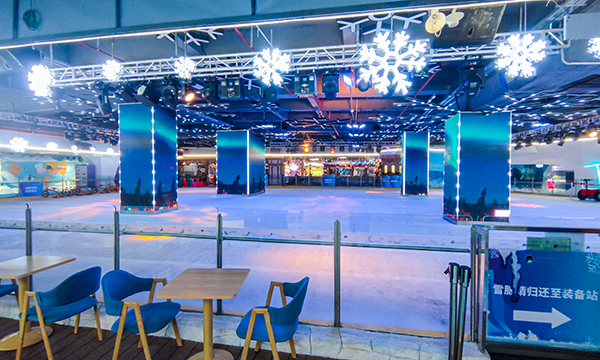

China’s ice-and-snow market in 2026 is no longer coasting on Beijing 2022. Policy funding, lower-carbon refrigeration and a change in who pays for skating and skiing are now shaping demand together. For venue developers, the opportunity is real, but it is not a case for building the same rink everywhere.
The strongest signals are coming from Beijing’s upgraded industry plan, southern indoor mega-complexes and hybrid venues that combine ice or snow with other uses. The engineering lesson is straightforward: match the format to foot traffic, calculate the load for the actual site, and treat controls and the envelope as part of the business model.

Beijing spent 2025–2026 rolling out the upgraded version of its ice-and-snow industry plan. The relevant measures include larger subsidies for technical retrofits of indoor venues, stronger incentives for green and low-carbon operations, dedicated funding for reserve-talent training pipelines, and tax breaks for ice-and-snow + tourism hybrids. Beijing is the anchor, but the funding logic and case studies can be exported elsewhere.
That policy floor matters because indoor ice and snow is capital-intensive and slow to amortize. Public support can improve the investment calculation, but it does not remove the need for a sound operating format. When assessing indoor ice and snow solutions, separate the retrofit opportunity from the new-build case, then test whether the venue can sustain visits and energy costs without relying on a headline subsidy.
Walk the indoor-ski pipeline in 2025 and 2026 and the bulk of new square metres is in the south: Guangdong, Yunnan, Fujian and Sichuan. These are markets where outdoor skiing is not a practical alternative. The southern and subtropical all-season indoor snow-and-ice complex has moved from niche format to dominant format, supported by progress in both insulation and refrigeration.
Insulation: High-density insulation has caught up. With proper detailing, 100 mm+ XPS boards cut conductive load hard enough that a 30,000-m² snow hall in Foshan is no longer a science project.
Refrigeration: R507 and new lower-GWP blends are carrying loads where CO2 is overkill. A wider install base has also brought unit cost down.
Design discipline: Neither point justifies a copy-paste plant schedule. Site-specific load calculation and custom dehumidification remain essential, especially where climate and venue scale differ.
For an owner reviewing indoor ski project options, the useful question is not whether a southern snow hall can be built. It is whether the envelope, refrigeration choice and operating plan fit that hall, that climate and that visitor model.
| Design factor | Development in the market | Practical takeaway |
|---|---|---|
| Insulation envelope | 100 mm+ XPS boards with proper detailing | Cut conductive load through envelope design |
| Refrigerant selection | R507 and lower-GWP blends where CO2 is overkill | Select for the project, not by copying another venue |
| Control architecture | PLC central control and multi-zone independent setpoints | Match operation to different venue zones |
| Southern scale example | A 30,000-m² snow hall in Foshan | Mega-complexes are no longer a science project |

A standalone rink or ski hill does not pencil out in most malls in 2026. The formats gaining traction stack ice or snow with another reason to visit, extending the value of the venue rather than relying only on skate sessions or lift tickets.
Ice-and-snow + kids’ education: MELAND-style indoor kids’ parks attached to a small ice surface are drawing family foot traffic in tier-1 and tier-2 mall anchors.
Ice-and-snow + action sports: Scooter parks, trampolines and skate zones can share HVAC with the ice plant, cutting both capital and operating expenditure.
Ice-and-snow + retail and F&B: This experience-anchor model gives malls a format that can convert visits into dwell time, something they have sought for a decade.
The design implication is to plan the shared systems and the visitor mix together. Assess whether the proposed combination supports foot traffic and whether shared services suit the ice plant. Shared HVAC is a specific advantage in the action-sports model; do not assume the same capital and operating benefit for every hybrid without project analysis.
The intelligent label on a refrigeration control panel used to be marketing. In 2026 it is paying rent. The useful stack is PLC-based central control with multi-zone independent setpoints, remote digital-twin monitoring and integrated energy dashboards tied to the building’s BMS. Monitoring can catch a drifted expansion valve before it costs a slab of ice.
Venues running this stack report 15–20% lower facility energy than the same floor area on legacy controls. On a 20,000-m² snow hall, that delta can amount to six to seven figures a year depending on the local tariff. Treat it as a reported operating outcome, not a guaranteed saving for every project. Your tariff, zones, envelope and actual control logic still determine the result.
For an existing venue, start by comparing energy and ice-quality performance against the operating intent. For a new venue, include controls in the design discussion instead of adding dashboards after the plant is fixed. The commercial value comes from stable operation, earlier fault detection and visibility across zones.
Yangsheng has spent 15 years in refrigeration plant design, dehumidification, high-spec insulation envelopes and long-tail service contracts that keep an ice surface flat for a decade. Its work includes the snow system at Guangzhou Sunac Snow World, smaller commercial rinks in malls in Foshan and Guangzhou, and climate-controlled friction labs used by national teams.

Those are very different climates and scales, but the common thread is site-specific load calculation, custom dehumidification design and no copy-paste equipment lists. That is also the right way to read the market: policy may support the build, and a hybrid format may bring visitors, but the plant and envelope still have to perform on the actual site.
Reviewing ice and snow project cases alongside environmental laboratory work can help frame that conversation around application rather than a generic equipment catalogue. If you are sizing a new project or troubleshooting one that is missing its energy or ice-quality targets, the engineering team can run a side-by-side model using your actual site data.
Beijing is the anchor, but its funding logic and case studies get exported to the rest of the country. Confirm the measures applicable to your location; do not assume a Beijing line item automatically applies elsewhere.
The bulk of new indoor-ski square metres in the 2025 and 2026 pipeline is in Guangdong, Yunnan, Fujian and Sichuan. Improved high-density insulation and refrigeration have helped make all-season complexes viable where outdoor skiing is not realistic.
Start with actual site data and a side-by-side engineering model. Check the load basis, dehumidification, insulation envelope, zoning and controls together; the appropriate approach is explicitly site-specific rather than based on a copied equipment list.
If you are planning a retrofit, a southern snow complex or a hybrid mall attraction, bring your site data and operating goals to Yangsheng Ice and Snow. A project-specific review of load, dehumidification, insulation and controls is the practical next step before committing to a format or equipment list.