
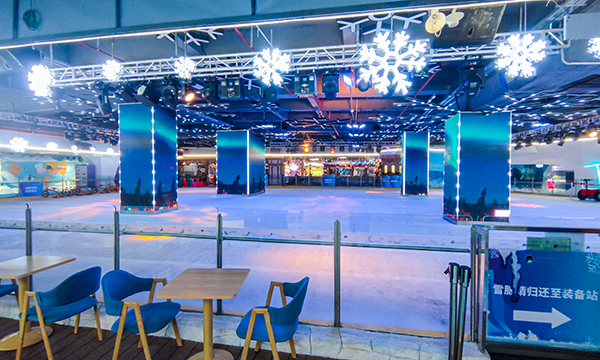
For an indoor ski venue expected to run for 20 years or more, refrigerant selection is not a late procurement detail. It affects approvals, energy consumption, heat recovery and the risk of a major retrofit before the asset reaches mid-life.
Transcritical CO2, or R744, can be a strong option, but only when its climate performance and high-pressure design are modeled for the actual site. Here is how I would weigh it against ammonia and HFC systems before freezing the specification.

Ammonia (R717) is an excellent refrigerant on paper, but it is toxic and flammable. In a shopping mall, tourism complex or another venue where the public walks within the plant room’s exclusion zone, that can mean a prolonged approvals process. Mandatory gas detection, forced-ventilation upgrades and insurance loadings also weaken the assumption that ammonia is simply the low-cost option.
HFCs such as R507 and R404A create a different exposure. Their GWP values are in the thousands, and the Kigali Amendment to the Montreal Protocol is driving phase-down pressure across major markets. Specifying one in a new project can commit the owner to a mid-life retrofit, typically 30–40% of original capex, within the next decade. For owners comparing indoor ski solutions, that is an asset-life issue, not a footnote on the refrigerant schedule.
R744 has a GWP of 1 and is non-toxic and non-flammable, with an ASHRAE A1 classification. In cold-winter and temperate climates—including northern and northeast China and the temperate belt across central China—CO2 spends most of its operating life in subcritical mode. Measured winter COP runs 15–30% above comparable HFC systems; on a large indoor snow hall, that can mean roughly a quarter off the annual cooling bill.
The second advantage is load integration. CO2’s temperature glide during transcritical heat rejection can be matched to space cooling, sub-floor frost prevention and dehumidification. Instead of treating these as disconnected duties, the design can use one integrated loop for three jobs, without a parallel ammonia skid. When reviewing refrigeration and snow equipment, assess that loop as a complete system rather than comparing compressor prices alone.
Heat recovery is the third advantage. Transcritical discharge runs at 90–120 °C, and a well-designed package can recover 60–80% as high-grade heat for:
Floor heating within the facility.
Snow-melt in the access area.
Domestic hot water.
Driving an absorption chiller in summer.
This cold-and-hot-from-one-source model can reshape the venue’s entire energy budget, provided the heat demands are real and properly matched.

Transcritical CO2 is not the cheapest line on the initial quotation. Capex is about 10–20% higher than a baseline HFC installation once high-pressure compressors, micro-channel gas coolers and thick-wall stainless pipework are included. The decision should therefore be made on life-cycle cost, with the key assumptions visible to everyone approving the project.
| Design factor | Figure or condition | Owner implication |
|---|---|---|
| Winter efficiency | COP 15–30% above comparable HFC systems | Validate against the site climate; do not apply it as a universal saving. |
| Discharge heat | 90–120 °C; 60–80% recovery with a well-designed package | Match recovered heat to floor heating, snow-melt, hot water or summer absorption cooling. |
| Initial capex | About 10–20% above baseline HFC | Include high-pressure compressors, micro-channel gas coolers and thick-wall stainless pipework. |
| Premium payback | Typically 3–5 years | Base the case on energy and refrigerant savings, then test it in the site model. |
| HFC retrofit exposure | Typically 30–40% of original capex | Include the avoided mid-life phase-out retrofit in a 20-year comparison. |
The premium typically pays back in 3–5 years from energy and refrigerant savings alone. CO2 also avoids the HFC phase-out retrofit, so the 30–40% reinvestment does not come due on a 20-year asset. Those outcomes still need project-specific validation; they are not a reason to skip modeling.
CO2 is not a drop-in replacement. High-side operating pressure reaches 130 bar, so every flange, valve and branch take-off must be designed and built for it. Parallel compressor staging and ejector technology have advanced quickly over the last five years, but good hardware does not rescue a weak design basis.
The system is also more sensitive to local climate data than an HFC design. A generic kW-per-m² rule can leave the promised COP unrealized. Use the site’s TMY data in a real model, then size both heat-rejection and heat-recovery loops from the results.
Before approving the design, I would require:
A site-specific energy model using typical meteorological year data.
A pressure-ready design covering compressors, gas coolers, pipework, valves and branches.
A heat-recovery calculation tied to actual uses, not a nominal percentage.
A life-cycle comparison using the same operating period and duties for every refrigerant option.
My recommendation is not “CO2 everywhere.” Beijing Yangsheng has built refrigeration systems using CO2, ammonia and new low-GWP blends. The right choice depends on the site, facility size and how long the owner intends to hold the asset. Reviewing ice and snow project cases can help frame the options, but the final comparison should use your own loads and climate file.
A natural-only refrigerant line-up can support LEED, China’s Three-Star Green Building and ESG reporting that may open doors to green credit. Some operators have also converted it into a rent and rate premium with anchor tenants carrying decarbonization targets. Treat those as potential project benefits, not guaranteed income, and keep them separate from the energy model until they are contractually supported.
Not on initial capex: the premium is about 10–20% over baseline HFC. The typical 3–5-year payback applies to that premium and comes from energy and refrigerant savings. Whether CO2 wins for your venue depends on the site, size, operating climate and ownership period.
No. A generic kW-per-m² rule is particularly risky for CO2 because performance is climate-sensitive. Run the actual site’s TMY data through a real model, and size heat rejection and heat recovery from that analysis. Then coordinate the 130 bar high-side design across every component.
R744’s GWP of 1, non-toxic formulation and non-flammable A1 classification remove important concerns associated with HFCs and ammonia. They do not make the system a drop-in or eliminate engineering work. Pressure design, component selection, modeling and the applicable project approvals still belong in the delivery plan.
If you are weighing CO2 against ammonia or low-GWP alternatives on a real project, contact Yangsheng Ice and Snow. Our engineering team can build a site-specific energy model and full life-cycle cost comparison—TMY data in, numbers out—so you can select the refrigeration strategy on evidence rather than a rule of thumb.