
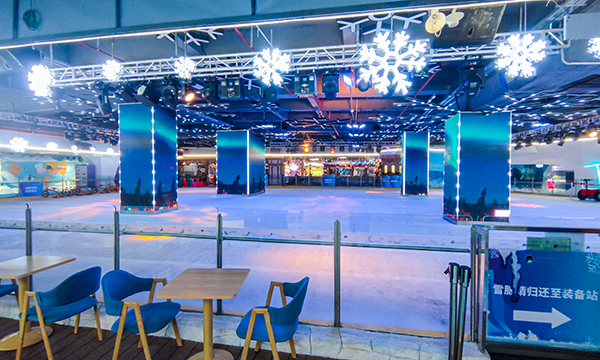
A small dehumidifier may get a northern rink through winter. In southern China, the same attempt to save money can leave the ice white, the arena foggy and the ceiling dripping. Ice quality falls, customers complain, and the building itself begins to absorb the cost of poor humidity control.
A 600 m² rink in Guangzhou faces air carrying two to three times more moisture than the same rink in Beijing in July. That moisture condenses on cold surfaces, and the ice is the coldest surface in the building. Dehumidification therefore belongs in the base design, not in a list of optional extras.

Dehumidifier selection should begin with the ice surface area and the project’s humidity zone, not with an equipment catalogue or a household unit’s advertised convenience. When we develop indoor ice and snow solutions, the required moisture-removal rate is the starting point for a system that can protect both skating conditions and the building.
Use the following ranges as the practical design basis. The figures are kilograms of moisture removed per hour for each 100 m² of ice surface:
| Project region | Dehumidification capacity per 100 m² |
|---|---|
| South China, high humidity | 4–6 kg/h |
| Central China and East China | 2–3 kg/h |
| North and dry regions | 1–2 kg/h |
For a 600 m² rink in Shenzhen, the high-humidity range produces a minimum requirement of 24–36 kg/h. A portable household unit provides 0.5 kg/h. The difference is why adding small machines after fog appears does not address the actual moisture load.
This calculation is only the capacity check. The equipment still has to receive humid fresh air safely, respond to arena conditions and deliver dry air without damaging the ice. Those details determine whether the nominal capacity becomes useful humidity control.
The dehumidifier must be linked to the refrigeration control system. We run dehumidifiers, chillers and ice surface temperature control through the same PLC, using the Siemens S7-1200 series. Humidity sensors are spaced no more than 20 m apart. When humidity crosses its threshold, the system automatically starts or stops the dehumidifiers, without waiting for manual intervention.
The logic connecting the dehumidifier to the refrigeration start sequence is hard-coded into the PLC. It is not an optional setting or something left for operators to remember. This matters because humidity control is part of the operating sequence of the ice rink refrigeration system, not a separate appliance running beside it.
For the venue owner, the practical requirement is clear: ask how the controls respond when humidity rises, where the sensors are located, and whether fresh air is treated before it enters the arena. A clear answer is more useful than a promise that the building will simply “stay dry.”

Many projects pull outdoor air straight into the arena. In a humid climate, that pumps moisture toward the cold ice. The air path and discharge direction need to be designed together:
Dehumidify fresh air first. Outside air must pass through the dehumidification section, reach the target moisture content, and only then enter the building. Any other sequence creates a humidity leak.
Keep the outlet away from the ice. Dry air leaving a desiccant rotor is warmer than ambient air. Blowing it directly at the rink can melt the surface layer.
Let the air mix. Direct the outlet toward the ceiling or a side wall so natural circulation can distribute the dry air.
The desiccant rotor also needs planned replacement. Silica gel adsorption capacity falls over time, and the standard replacement cycle is 2–3 years. If this is skipped, efficiency can fall below 60%. At that point, the venue is paying to run a machine that barely works. Put rotor replacement into the maintenance contract rather than relying on someone to notice declining performance.
For Shenzhen and Guangzhou projects, dehumidification is not an option line item. The budget ranges for dehumidification systems are:
600 m² rink: 30,000–60,000 RMB.
800 m² rink: 50,000–80,000 RMB.
Rinks of 1,000 m² or more: configure by humidity zone, typically 80,000–150,000 RMB.
These figures belong in the project budget from the beginning. Cutting the line can look attractive during procurement, but three months later a venue might lose more than that amount in three days of forced closure. Review our ice and snow project cases alongside your own floor plan, city and humidity concerns before fixing the scope.
The damage also follows a recognisable timeline. At months 4–6, ceiling metal components can begin rusting, and rust water can drip onto the ice. During the first summer, constant surface fog, declining ice quality, slips, falls and complaints can lead to capacity limits or closed days.
Within the first year, moisture-soaked ceiling decoration layers can begin falling off; the repair can cost more than the dehumidifier. Over the long term, condensation inside the building envelope soaks the insulation, reducing its R-value. Refrigeration electricity costs can then climb by 30–50%. The apparent saving has become an operating and building-maintenance problem.

A household unit provides 0.5 kg/h, while the 600 m² Shenzhen example needs 24–36 kg/h at minimum. Portables also do not solve the required fresh-air treatment, PLC coordination or safe outlet direction. The issue is system capacity and integration, not simply the number of machines placed around the rink.
Air leaving a desiccant rotor is warmer than ambient air. Aiming it at the ice can melt the surface layer. Facing the outlet toward the ceiling or side wall allows natural circulation to mix the dry air through the arena instead of using the ice as the discharge target.
For a southern China rink, yes. Without it, the venue is managing a humidity problem with a skating surface attached. Fog, condensation, corrosion, damaged finishes and rising refrigeration electricity use all follow when moisture is left uncontrolled. Dehumidification belongs in the same essential design category as the chiller.
Yangsheng Ice and Snow has designed and built ice rinks in South China for 15 years. If you are planning a venue or already fighting humidity, send your floor plan and city to Yangsheng Ice and Snow. We will size the dehumidification system and run the numbers, then coordinate it with refrigeration design, construction and turnkey delivery.