
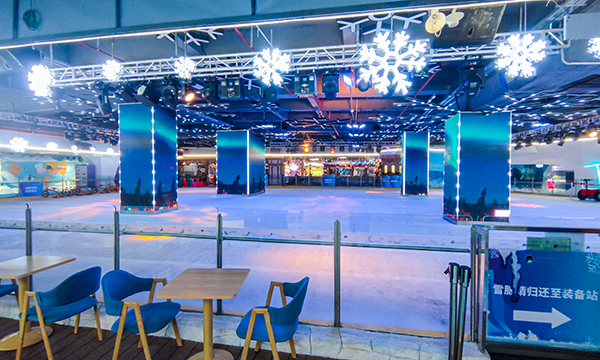
Refrigeration is the largest energy demand in an ice and snow venue, accounting for over 60% of total energy consumption. It also shapes long-term operating costs and project profitability. For an owner, efficiency is therefore not a decorative specification; it is a core design requirement that must survive daily operation.
A low-energy, high-stability venue cannot be created by choosing one efficient machine. Equipment selection, system design, material application, and intelligent operation and maintenance must work together. The following framework shows where to focus during planning, procurement, and an upgrade, without losing sight of ice condition and operational stability.

Start with the coefficient of performance (COP), but compare units at the same cooling capacity. Traditional reciprocating units typically have a COP below 3.0. Variable-frequency screw units and transcritical CO₂ direct cooling units can achieve 4.5–6.0, with energy consumption reduced by 20%–35% under the same cooling capacity. Those figures make selection important, but they do not remove the need for correct load calculation.
| Equipment or comparison | Performance data | Practical meaning |
|---|---|---|
| Traditional reciprocating units | COP typically below 3.0 | Compare against higher-COP options |
| Variable-frequency screw and transcritical CO₂ direct cooling units | COP can reach 4.5–6.0 | Prioritize efficiency at the required cooling capacity |
| Same cooling capacity comparison | Energy consumption can be 20%–35% lower | Do not treat the potential saving as a substitute for load matching |
Transcritical CO₂ direct cooling also supports combined heating and cooling. Waste heat can be recovered for venue heating and hot water, improving overall energy use rather than focusing only on the refrigeration circuit. When reviewing an ice rink system, ask the supplier to explain both the unit efficiency and how recovered heat will be used in the venue.
Next, match the plant to the actual load. Calculate cooling demand from ice surface area, usage scenario—competition or recreation—and ambient temperature. Then select the appropriate number and capacity of units. Over-sizing can leave equipment operating at low load for long periods, reducing energy efficiency. A selection based only on a generous capacity margin can therefore work against the operating result you are trying to achieve.
Efficient equipment cannot compensate for avoidable distribution losses. Use short-run, co-directional pipe layouts, minimize bends and pressure losses, and design for uniform cooling distribution. Insulate pipes with closed-cell rubber-plastic insulation and protect them with an aluminum foil layer. This is a detailing issue as much as a procurement issue: routing, insulation continuity, and protection should be clear in the design.
Below the ice, pipe spacing and routing influence energy consumption as well as temperature uniformity. Scientifically optimized layouts produce more uniform ice surface temperatures and reduce the frequency of unit start-stops. Coordinate these decisions within the wider indoor venue solution, rather than treating the pipe drawing as an isolated refrigeration exercise.

Add PLC-based smart control to adjust cooling capacity according to time of day and foot traffic. Zone temperature control for different functional areas, including the ice rink, rest areas, and snow zones. The purpose is straightforward: deliver the conditions each area requires while preventing overcooling in non-essential areas. A single operating approach across unlike spaces can discard savings achieved elsewhere.
The structure beneath the ice must retain cooling capacity and protect the building. Install high-density polyurethane insulation panels of at least 100 mm, together with a moisture-proof vapor barrier. This assembly blocks the transfer of cold energy to the building structure, helps prevent condensation and frost heave on the floor slab, and reduces cooling load. Omitting either thermal or moisture control undermines the purpose of the layer.
At venue level, use insulated rock wool in exterior walls and roofs, double-pane glass, and effective door and window sealing to reduce outdoor heat intrusion. Review the ice structure and envelope as one heat-loss problem. Better refrigeration control cannot remove heat that the building repeatedly admits, and insulation cannot correct poor distribution on its own. Both belong in the energy review before equipment selections are finalized.
Energy performance has to be maintained, not assumed from commissioning. Heat exchange surfaces, refrigerant condition, and operating data all require routine attention. Build the following actions into the venue’s operation and maintenance plan:
Clean heat exchange equipment: Clean condensers and evaporators regularly to maintain heat exchange efficiency. Keep this work in the normal maintenance routine rather than waiting for a decline in venue performance.
Protect refrigerant and pipe integrity: Monitor refrigerant purity and pipeline integrity to prevent the efficiency losses caused by leaks.
Analyze consumption: Establish an energy consumption data analysis system to identify abnormal energy use promptly. Use the findings to optimize operating strategies rather than simply archiving utility data.
This discipline also makes control settings easier to assess. If energy use becomes abnormal, the data system provides the prompt to investigate; cleaning and integrity checks address two potential sources of loss. The aim is long-term, stable savings, with corrective action based on observed performance rather than guesswork. Zone control and cooling-capacity adjustment should remain active operating tools, not commissioning features that are later ignored.
An owner should procure an integrated result, not a collection of disconnected components. Beijing Yangsheng Ice and Snow Technology provides services from planning and design through engineering, construction, and O&M management. Its core lightweight, low-energy-consumption ice rink system is stated to reduce floor load by 30% and refrigeration energy consumption by 25%. Keep these supplier-specific figures distinct from general project targets and confirm how they apply to your scheme.
Yangsheng has served dozens of real-ice rinks and ice and snow theme park projects nationwide, covering commercial complexes, cultural and tourism attractions, and campus facilities. When assessing a supplier’s project portfolio, look for relevant venue types and ask how design, construction, and operational support are connected. The company also states 30-day rapid delivery and lifetime operational support.

For an upgrade, begin with the existing load, pipework, insulation, controls, and maintenance records. For a new venue, carry the same questions into planning before equipment choices become difficult to change. In either case, judge the proposal on the complete path from cooling production to ice condition and continuing operation. That keeps procurement focused on stable performance and controlled energy consumption.
Start with an accurate cooling-load calculation and unit selection, because those decisions establish the plant’s operating basis. Then coordinate pipe layout, controls, ice insulation, and the building envelope. Choosing a high-COP unit without this system work leaves other losses in place and does not provide the systematic optimization required for a low-energy, high-stability venue.
Yes. Transcritical CO₂ direct cooling supports combined heating and cooling, allowing waste heat recovery for venue heating and hot water. That can improve overall energy efficiency. Its value should therefore be assessed alongside COP, load matching, and the venue’s ability to use the recovered heat, rather than judged only by the refrigeration unit in isolation.
Clean condensers and evaporators regularly, monitor refrigerant purity and pipeline integrity, and use energy consumption data analysis to identify abnormalities. Zone control and capacity adjustment should continue to reflect time of day and foot traffic, so the venue does not drift into unnecessary cooling. The objective is to detect losses and adjust operating strategies promptly.
If you are planning a new venue or upgrading an existing one, bring Yangsheng Ice and Snow into the discussion before selections are fixed. Contact Yangsheng Ice and Snow for a customized energy-saving design solution covering planning, engineering, construction, and long-term operation, and build your project around stable ice, controlled energy use, and practical maintainability.