
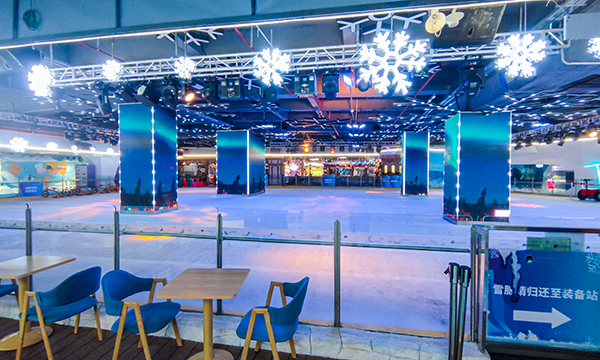
“How much per square meter?” is usually the first question I hear from a venue owner. It is also the wrong place to start. Indoor ice and snow facilities are special engineering projects: scale, site condition, refrigeration, insulation, supporting facilities, and local approvals all move the budget.
This 2026 guide compares community rinks, commercial ice and snow venues, and professional ski resorts. Use the ranges to frame a feasibility budget, then test each quotation against ice quality, energy use, and rework risk—not simply the lowest initial price.

A community rink, a mid-sized park, and a professional ski resort do not buy the same scope. Renovating an old factory or commercial space can add civil engineering, structural reinforcement, and fire-safety upgrades. Define whether you are building a pure ice rink or a complex with slopes, snow play, dining, and retail before comparing equipment. That scope should drive the indoor ice and snow solutions you specify, rather than being added piecemeal after design.
Scale and positioning: community rinks, medium ice and snow parks, and large professional resorts have sharply different costs.
Site conditions: new construction and renovation carry different allowances for civil works, reinforcement, and fire-safety upgrades.
Core equipment: refrigeration and snowmaking are the heart of the project. Price gaps between imported and domestic equipment, and between direct and indirect cooling, can exceed 30%; the choice also affects operating energy.
Insulation and enclosure: insulation is the venue’s lifeline. Inadequate standards can double later energy consumption, while higher initial standards change construction cost.
Supporting facilities: training, entertainment, competitions, equipment rental, food, and retail change both the build scope and potential revenue mix.
Geography and policy: labor, materials, and approvals vary by city. Most provinces and municipalities offer winter-sports or cultural-tourism subsidies covering up to 30% of total investment, but this should not be treated as automatic.
A square-meter rate is therefore a screening tool, not a fixed quotation. Start with use, site, and envelope, then price the systems.
Treat these ranges as budget frames, not fixed quotations. Small rinks have the lowest entry barrier and fastest return on investment; mid-sized commercial venues are the current mainstream. Large resorts expand the scope to multiple slopes, extensive snow play, and hotel or commercial support.
| Facility | Standard or professional option | Upgraded option | Primary fit |
|---|---|---|---|
| Small community or mall rink, 100–500 m² | Basic: 8,000–12,000 RMB/m²; total investment 800,000–6,000,000 RMB | High-end custom: 12,000–18,000 RMB/m²; total investment 1.2–9.0 million RMB | Mall traffic, community sport, and children’s skating training; primarily real ice without a snow slope |
| Mid-sized commercial or cultural-tourism venue, 500–3,000 m² | Basic: 10,000–15,000 RMB/m²; total investment 5–45 million RMB | High-end themed: 15,000–22,000 RMB/m²; total investment 7.5–66 million RMB | Real ice, beginner slopes, snow play, training, entertainment, and small-scale competition |
| Large professional ski resort or snow park, 3,000 m² and above | Professional standard: 12,000–20,000 RMB/m²; total investment starting at 36 million RMB | International competition grade: 20,000–35,000 RMB/m²; total investment starting at 100 million RMB, with no upper limit | Regional destination, professional training base, multiple slopes, real ice, snow play, and full supporting facilities |
Small sites suit mall atriums, community commercial complexes, and small sports venues. Mid-sized projects fit large complexes in Tier 1 and Tier 2 cities or flagship cultural-tourism projects in Tier 3 and Tier 4 cities. Large projects serve regional destinations, training bases, and landmark resorts. For slope-led schemes, price refrigeration, snowmaking, and civil works as one coordinated scope.

Across the core components, these are the cost ranges. Their percentages vary by facility type, so do not force every line into one generic template.
Refrigeration: 30%–40% of total cost. It determines ice or snow quality, equipment life, and long-term energy use. Mainstream direct cooling is over 30% more energy-efficient than traditional indirect cooling, while costing 10%–15% more initially. When reviewing an ice rink system scope, check the lifecycle trade-off rather than accepting low-quality equipment to reduce the quote. Cutting quality can bring hundreds of thousands in additional electricity spending each year, frequent ice thawing, and rework.
Ice and snow surfaces plus snowmaking: 15%–20%. A real ice surface includes a base layer, insulation, waterproofing, refrigeration piping, concrete, and the ice layer. Each layer affects quality. Indoor slope systems include snow guns, snow spreaders, and grooming equipment. Domestic equipment offers strong value; imported equipment offers greater stability. Match snowmaking equipment options to project positioning instead of treating either route as universally best.
Insulation and enclosure: 15%–25%. Floor, wall, and ceiling insulation, thermally insulated doors and windows, air curtains, and dehumidification all belong in scope. Omitting them allows severe heat loss and can double long-term energy consumption. This is not a finish package to value-engineer late.
Supporting functions: 10%–15%. Lighting, smart security, ticketing, rentals, changing rooms, showers, and rest areas form the basic amenity scope. High-end venues may add dining, retail, and themed entertainment, increasing cost while broadening profit potential.
Design, construction, and installation: 8%–12%. Refrigeration, insulation, electrical and plumbing systems, and fire safety need coordinated planning during design. This is specialized engineering, not ordinary decoration. Projects managed by non-professional teams face a 90% or higher likelihood of substandard ice, excessive energy use, or fire-safety non-compliance, with rework costing far more than design fees.
Cost control should remove scope confusion, not critical layers or engineering quality. I would test every proposal in this order:
Separate new-build and renovation allowances. Confirm civil works, reinforcement, fire upgrades, and approval requirements before comparing unit rates.
Compare refrigeration on initial price, energy use, ice reliability, and lifecycle cost. A cheaper quote can become the more expensive operating asset.
Lock the enclosure and supporting-system scope during design. Check any subsidy locally before counting it as funds, and review ice and snow project cases to inform scope discussions; your own site conditions still need to be priced.
No. The ranges only become useful after scale, positioning, site condition, equipment, enclosure standards, amenities, and geography are defined. A renovated factory and a new build with the same floor area can carry different civil, reinforcement, and fire-upgrade costs.
Direct cooling carries a 10%–15% higher initial cost, but mainstream systems are over 30% more energy-efficient than traditional indirect cooling. Assess that premium against long-term electricity use and ice reliability rather than judging the refrigeration package on purchase price alone.
Most provinces and municipalities offer special subsidies for winter sports and cultural tourism, covering up to 30% of total investment. Because labor, materials, approvals, and policies vary by city, verify the local position before treating any subsidy as secured funding.
If you are planning a mall rink, cultural-tourism venue, or professional ski project, give Yangsheng Ice and Snow your site area, new-build or renovation status, planned attractions, and equipment preferences. Ask for a coordinated scope covering refrigeration, snowmaking, insulation, supporting systems, and design before construction, so the budget protects opening-day quality and long-term operating cost.