
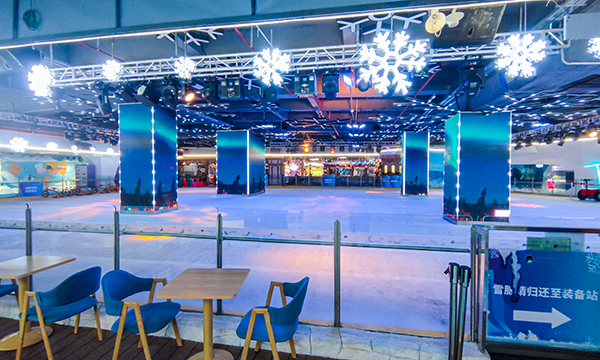
After a couple of seasons operating a 600 m² real ice rink, many owners discover that the monthly electricity bill, not equipment depreciation, is the quiet budget drain. In a typical indoor rink, refrigeration runs year-round, and electricity alone can represent 30 to 40% of total operating cost.
The useful response is not a broad promise to save energy. It is to inspect four places where power is commonly lost: condensing temperature, glycol condition, dehumidification and heat recovery. Whether you operate a plant or are planning an ice rink project, start with measurements, then correct the cause.

Compressor power draw is tied almost directly to condensing temperature. The hotter the refrigerant condenses, the harder the compressor works. The industry rule of thumb is that every 1 °C rise in condensing temperature reduces cooling capacity by about 3% and increases power consumption by about 2 to 3%. Pulling that temperature down therefore reduces both strain and electricity use.
A fouled condenser is the most common reason the temperature drifts upward. Dust, catkins and oil film block heat transfer on air-cooled fins. In a water-cooled plant, scaled cooling-tower fill and uneven water distribution push condensing pressure up. The corrective work is straightforward:
Wash air-cooled condenser fins quarterly with a pressure washer or coil cleaner.
Check cooling-tower spray nozzles and fill annually, and descale them.
Ventilate the plant room so multiple units do not dump hot air into one another.
Where budget allows, fit variable-speed drives so condenser fan speed tracks the load.
These are basic maintenance tasks, not exotic upgrades. Done consistently, they keep condensing temperature in a sensible band; shaving 10% off the summer power bill is normal. When reviewing ice and snow equipment, include cleaning access, ventilation and fan control in the discussion rather than treating them as afterthoughts.
Most rinks use indirect refrigeration: the compressor cools glycol, and that glycol circulates through pipes beneath the ice. Its concentration determines both freeze point and heat-transfer performance. An incorrect concentration can raise the freeze point and drag down heat-transfer efficiency, forcing the compressor to work harder for the same cooling load. At the worst end, glycol can freeze inside the under-ice pipes and burst them.
There is also a slower chemical problem. Glycol oxidises over time, producing acidic oxidation products. As pH falls, the loop can attack pipework, the plate heat exchanger and pump impellers. A leaking heat exchanger or burst pipe is then a major repair, not an efficiency tweak.
Check concentration and pH once a year. Set the freeze point about 8 to 10 °C below the lowest evaporating temperature; the typical concentration is 40% at a temperate site and 50% at a cold site. Treat pH below 7 as a warning and change the fluid before acid damages expensive components. At fluid changes, use purpose-formulated rink glycol with its inhibitor package already included. Generic industrial glycol may look cheaper on the invoice but cost more over the plant's life.

In a warm, humid climate, moisture can be the silent power drain. The ice pad sits at about -3 to -5 °C while building air is at 10 to 15 °C. That temperature difference, combined with a busy public session, drives indoor humidity up. Humid air reaching the ice causes surface icing and fog, damages ice quality and leaves the refrigeration system handling latent heat that dehumidification should remove. On many rinks in southern China, the dehumidification plant draws about as much power as the refrigeration plant.
A weak dehumidification design, or reliance on refrigeration to handle humidity as a side effect, leaves the electricity bill stubbornly high. Install a dedicated dehumidification plant sized for the load and keep the building slightly pressurised so humid outdoor air does not migrate through the doors. A door curtain or air lock at the main entrance can pay for itself in months. Check the dehumidification coils and reheat coil regularly, just as you check refrigeration coils.

Refrigeration also produces a valuable stream that many rinks discard: rejected condenser heat. The compressor normally dumps it to atmosphere, even when the facility needs hot water for changing rooms, space heating and snow-melt systems. A typical commercial rink can usefully recover 30 to 40% of that rejected heat. Across a year, this often means five figures of saved electricity or gas, with typical payback on the recovery equipment of one to three years.
There is a second benefit. A well-designed recovery system steadies the condensing loop and lets the compressor run at a more favourable condensing temperature. It can therefore save refrigeration power before the value of the recovered heat is even counted.
Heat recovery must be planned at design time. A later retrofit can mean re-piping the plant room, adding storage and re-engineering controls, at a cost that may no longer make sense against the equipment's remaining life. The right moments are the original build or a major refit. Make recovery part of the indoor venue design, alongside the refrigeration plant and the building's hot-water and heating demands, rather than an optional extra at the end.
Refrigeration efficiency is not one large intervention. It is four smaller actions done consistently. Use the following table as a practical inspection brief, then keep the checks on a recurring maintenance schedule.
| Place to act | Practical action | What it buys |
|---|---|---|
| Condensing temperature | Clean coils, ventilate the plant room and use variable-speed fans where budget allows | Around 10% summer power saving |
| Glycol management | Annual concentration and pH check; purpose-formulated fluid | Efficiency and major-repair avoidance |
| Dehumidification | Dedicated system and building pressure control | Visible peak shaving |
| Heat recovery | Plan the system at the design stage | 30 to 40% of rejected condenser heat recovered |
Wash air-cooled condenser fins quarterly. Check cooling-tower spray nozzles and fill annually, with descaling. Test glycol concentration and pH once a year, and inspect dehumidification and reheat coils regularly. These intervals address different problems, so one annual visit should not replace the quarterly condenser clean.
Relying on refrigeration to handle humidity as a side effect can leave the power bill unchanged when dehumidification design is weak. In warm, humid conditions, use a dedicated plant sized for the load, control building pressure and maintain its coils. This protects ice quality while removing latent load from the refrigeration side.
It is most effective when included in the original build or a major refit. Retrofitting can require new pipework, storage and controls, which may not make economic sense against the remaining equipment life. At the design stage, typical recovery is 30 to 40% of rejected condenser heat, with equipment payback usually one to three years.
Like a car, rink refrigeration becomes quiet and economical when it is serviced properly rather than simply left to run. Contact Yangsheng Ice and Snow to review these four opportunities, plan the right maintenance scope and integrate heat recovery into a new build or major refit before efficiency is designed out of the plant.