
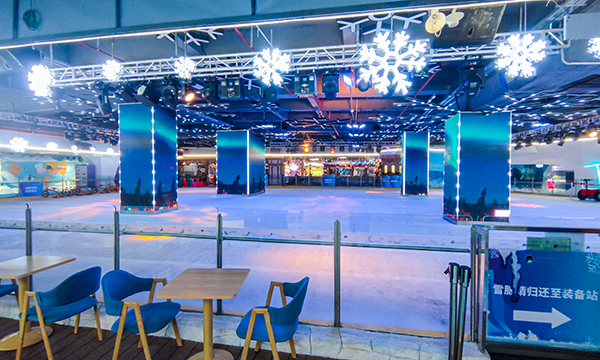
For a 600 sqm commercial real-ice rink, the practical budget is 2,200–2,500 RMB per sqm from design through opening day. That puts total spend at roughly 1.3M–1.5M RMB for the rink system, not simply for freezing a sheet of water.
This figure excludes rent, fire safety systems and base buildout. It covers refrigeration, the ice slab, dasher boards, installation and commissioning. Treat those elements as one operating asset: the choices made in the quotation will affect ice condition, stability and electricity use long after opening.
The gap between an early guess and a real quotation usually comes from scope. A rink is an engineering system that must keep running and keep consuming energy every day. When reviewing fixed ice rink systems, compare the complete design-to-opening scope rather than an equipment-only number.
| Budget area | Share | Practical scope |
|---|---|---|
| Refrigeration system | 35%–40% | Chiller, circulation pumps, piping and glycol secondary loop; typically 600k–700k RMB for 600 sqm |
| Ice slab construction | 25%–30% | Insulation, waterproofing, pipe grid, leveling and edge frost-heave protection |
| Dasher boards and safety gear | 10%–15% | Perimeter boards, glass panels, kick plates, entry and exit gates |
| Installation, commissioning and other work | 20%–25% | Labor, electrical and plumbing hookups, initial ice freeze and system tuning |
| Contingency | 5%–10% | Allowance to keep visible alongside installation and opening preparation |
Use the table to test whether a quotation is complete. If refrigeration appears attractive but slab layers, safety gear or commissioning are vague, the prices are not being compared on the same basis. A complete scope also makes the contingency easier to discuss before work begins, rather than after an omission surfaces.
The percentages are a useful checking tool, not an invitation to strip out the technical core. Refrigeration for the 600 sqm example, including the chiller, circulation pumps, piping and glycol secondary loop, typically accounts for 600k–700k RMB. Installation also needs its own budget: equipment supply alone does not deliver a rink ready to open.
The chiller is the heart of the rink and the largest line item. Do not size it to the lowest bid. Size it to your climate, use case and local electricity rate. An undersized chiller can leave the venue fighting melting ice and soaring power bills, turning an apparent saving into a daily penalty.
The slab is equally easy to misunderstand. Insulation, waterproofing, the pipe grid, leveling and edge frost-heave protection all sit beneath the visible ice. This construction influences whether the surface stays flat, how quickly it freezes back after resurfacing and what summer electricity consumption looks like.

Pipe spacing density is the hard metric. Widening the spacing may remove a few tens of thousands from the contract, but it sacrifices ice uniformity and energy efficiency. Because the grid is buried, the saving is easy to hide and difficult to see at handover. Keep both refrigeration capacity and pipe density out of the cost-cutting exercise.
Dasher boards and safety gear represent 10%–15% of the budget. Perimeter boards, glass panels, kick plates and entry and exit gates are non-negotiable for a commercial venue. Inadequate boards turn a skater collision into a safety incident, so this is not a decorative package to trim for a tidier quotation.
Installation, commissioning and the remaining work account for 20%–25%. That scope includes labor, electrical and plumbing hookups, the initial ice freeze and system tuning. It is the part outsiders most often miss: someone must install the equipment, get it running and hand over an opening-ready rink. Keep the 5%–10% contingency visible as well.

A mobile rink uses a modular ice surface, with refrigeration and slab built as detachable modules. It is fast to install, easy to dismantle and less dependent on location. Upfront cost is usually lower than for a fixed rink, which makes mobile ice rink options worth considering for mall-atrium activations, festival events and short-term projects that move around.
That lower entry cost does not make the two formats equivalent. A mobile rink does not match a fixed venue for per-square-metre experience density, long-term stability or peak-season refrigeration redundancy. For a long-term venue, choose fixed construction. For a quick-attraction pop-up, mobile is the smarter cost play. The operating plan should decide before the quotation does.
Value engineering is useful only when it protects performance. The source budget leaves many items negotiable, but three should hold the line:
Do not cut the chiller. Correct sizing can reduce unnecessary upfront spend while keeping monthly power costs under control; undersizing does the opposite.
Do not reduce pipe density. Before signing, put the pipe layout, spacing and acceptance criteria in writing, and include them in the acceptance standard.
Do not skimp on insulation. Insulation and vapor barriers help determine energy use for the next decade. Good insulation lowers cooling load, allows reasonable chiller sizing and helps keep electricity consumption low.
This approach also makes quotations easier to compare. Look beyond the headline total and check whether each bidder has preserved the same refrigeration scope, slab build-up, pipe requirements, safety equipment and commissioning scope. Reviewing relevant ice and snow project cases can help frame those scope discussions without treating a low equipment price as a finished-rink price.
Everything else is negotiable only after those three items are secure. That is how to reduce wasted spend without buying ten years of avoidable operating problems.

No. The 1.3M–1.5M RMB estimate excludes rent, fire safety systems and base buildout. It covers the rink system from design through opening: refrigeration, ice slab, dasher boards, installation and commissioning.
Cutting the chiller, reducing pipe density and skimping on insulation are the three to avoid. They threaten melting ice, uneven ice, poor energy efficiency and higher electricity costs. Lock down pipe layout, spacing and acceptance criteria before signing.
Its upfront cost is usually lower, but the use case matters. Mobile suits pop-ups, festivals and short-term attractions. A fixed rink is the better fit for a long-term venue that needs stronger stability and peak-season refrigeration redundancy.
An ice rink is not expensive because of the ice; it is expensive because stable operation and reasonable energy use have to be engineered. Bring your venue brief to Yangsheng Ice and Snow for design, refrigeration system construction and turnkey project delivery, and hold the line on the chiller, pipe density and insulation.